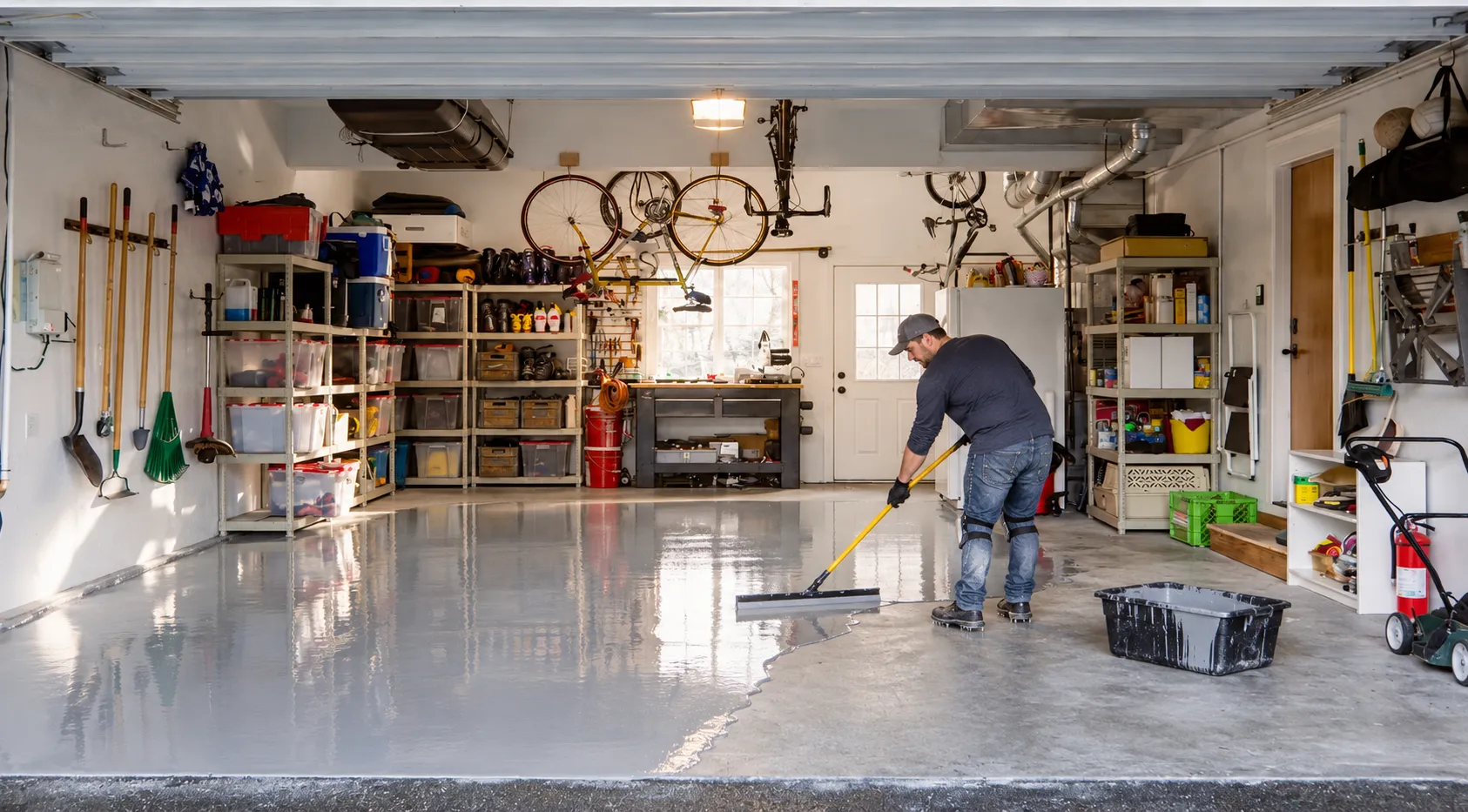

Epoxy flooring is a resin-based coating system that bonds to mechanically prepared concrete to create a hard, continuous surface for garages, homes, workshops and commercial floors.
In Western Australia, private-sector house approvals in May 2026 were 24.5% higher than a year earlier, reflecting continued activity across the residential construction market.
Perth’s climate also places specific demands on coated concrete: the city reached 43.6°C in 2025, while mean maximum temperatures across Greater Perth were above average.
Epoxy flooring is important because it protects concrete from wear, stains and daily traffic while creating a seamless surface that is easier to clean and maintain.
What Is Epoxy Flooring?
Epoxy flooring is a thermosetting resin coating applied over prepared concrete to create a bonded, durable floor surface.
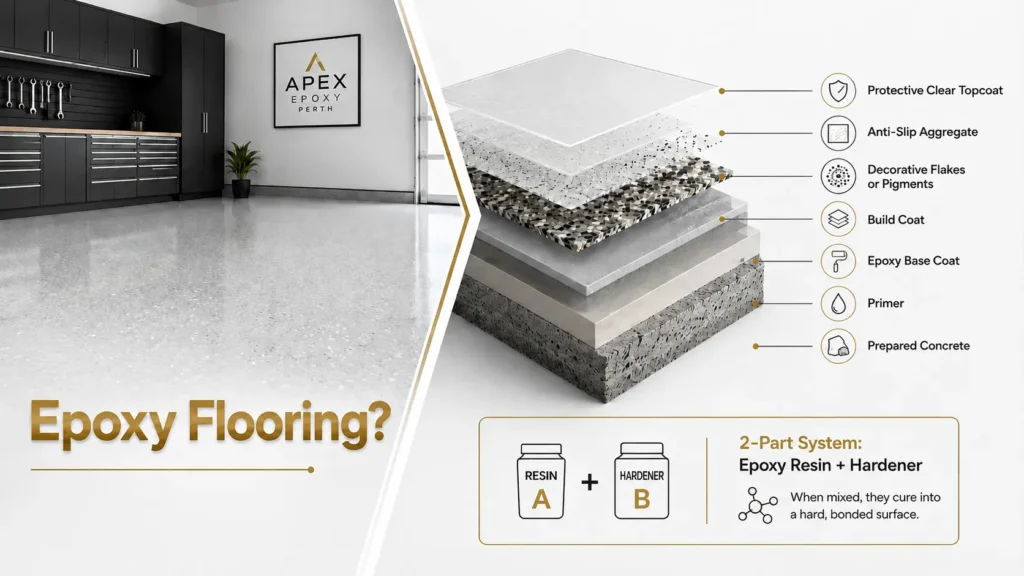
The coating is normally created from two main components:
- Epoxy resin
- Hardener or curing agent
When these components are mixed in the correct ratio, a chemical reaction begins. The liquid material gradually cures into a hard coating that adheres to the prepared substrate.
This is one of the main differences between epoxy flooring and ordinary concrete paint. Paint mainly creates a surface film. A properly installed epoxy system is designed to mechanically and chemically bond to suitably prepared concrete.
An epoxy floor can consist of several layers rather than one coat. Depending on the system, these may include:
- Primer
- Epoxy base coat
- Build coat
- Decorative flakes or pigments
- Anti-slip aggregate
- Protective clear topcoat
What Is Epoxy Flooring Made Of?
Epoxy flooring is primarily made from epoxy resin and a compatible hardener, with pigments, aggregates, flakes and protective topcoats added depending on the required finish.
The resin provides the base material. The hardener initiates the curing reaction that turns the mixed coating from a liquid into a solid surface.
Other materials can then modify how the floor looks or performs.
Common epoxy flooring components include:
| Component | Main Purpose |
| Epoxy resin | Forms the main coating body |
| Hardener | Reacts with the resin and allows it to cure |
| Primer | Improves bonding to prepared concrete |
| Pigments | Create solid colours |
| Decorative flakes | Add texture, colour variation and coverage |
| Silica or aggregate | Adds texture, thickness or slip resistance |
| Build coats | Increase coating thickness and durability |
| Clear topcoat | Protects the system from wear, stains and environmental exposure |
The exact formulation matters. Garage flooring, warehouse flooring and decorative interior flooring may all use different combinations even though they are described as epoxy flooring.
A floor should therefore be selected as a complete coating system, not simply by asking whether a product contains epoxy.
What Are the Main Types of Epoxy Flooring?
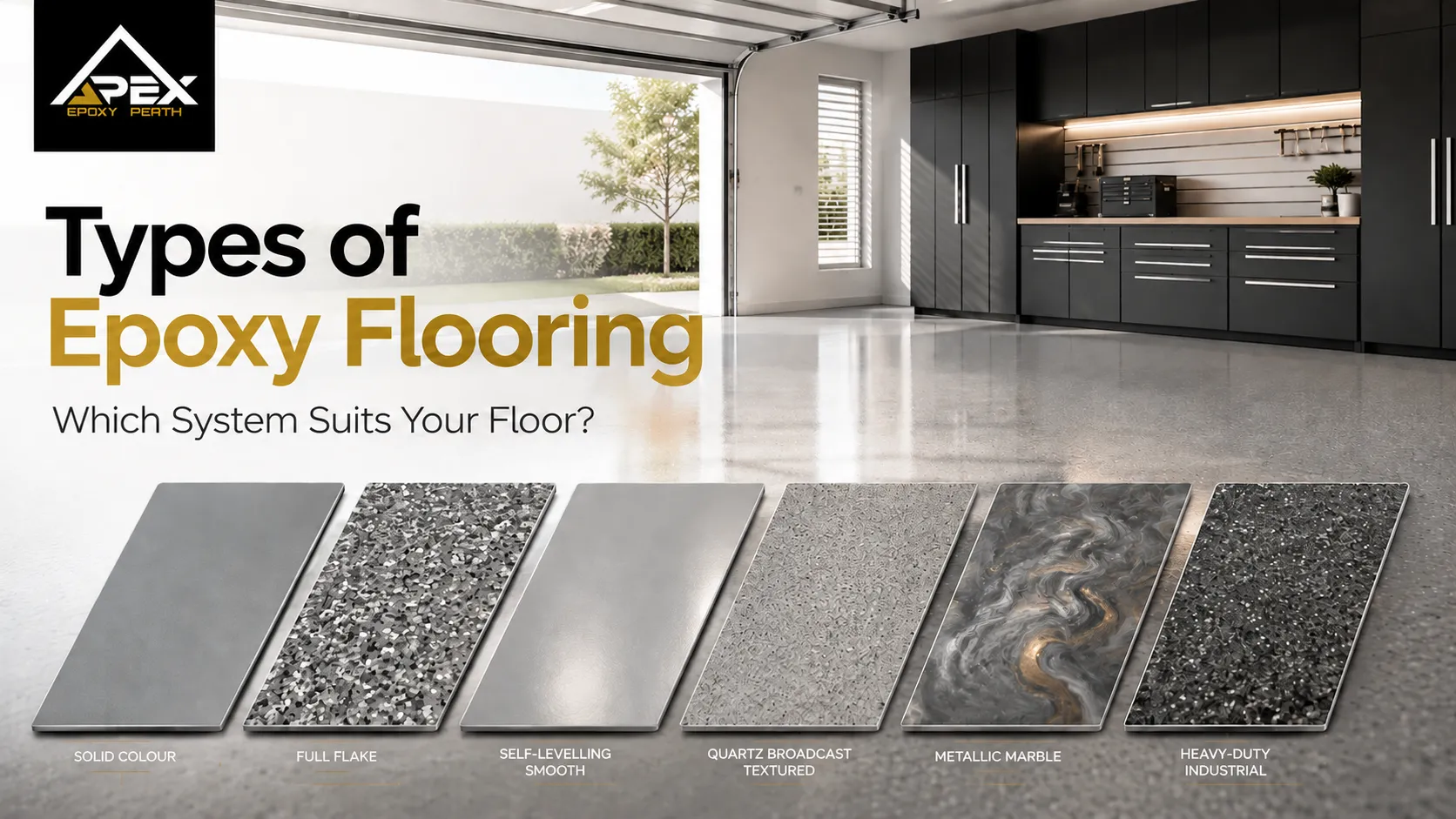
The main types of epoxy flooring include solid colour, full flake, metallic, self-levelling, anti-slip and heavy-duty commercial systems.
Each system provides a different combination of appearance, texture, durability and performance.
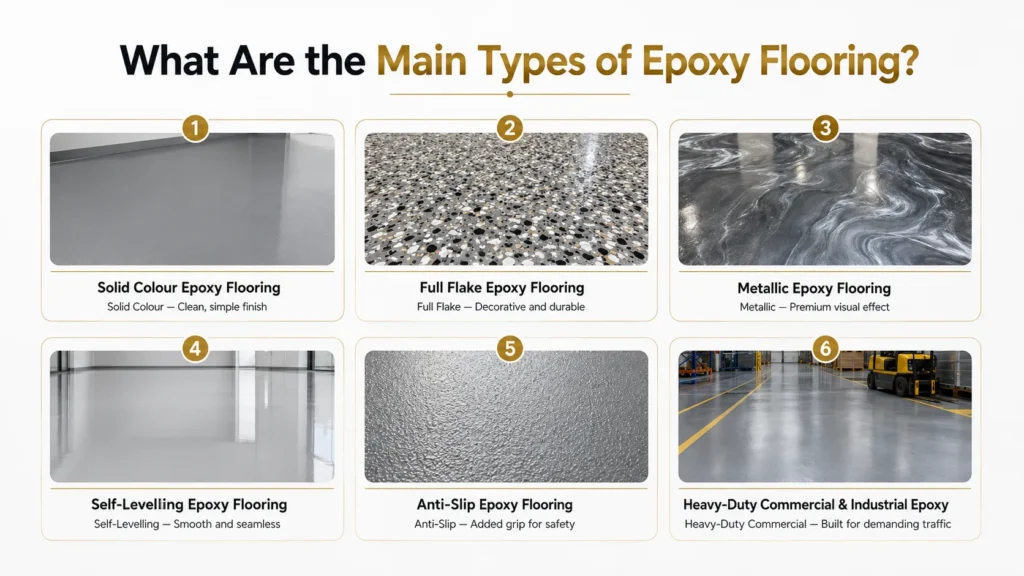
1. Solid Colour Epoxy Flooring
Solid colour epoxy flooring creates a continuous floor in one consistent colour.
It is commonly used where a simple, clean appearance is preferred. Colours such as grey, charcoal and neutral tones are widely used in garages, workshops and commercial areas.
A solid colour surface can also make dirt, scratches and imperfections more visible than a heavily flaked finish, so preparation and application quality are important.
2. Full Flake Epoxy Flooring
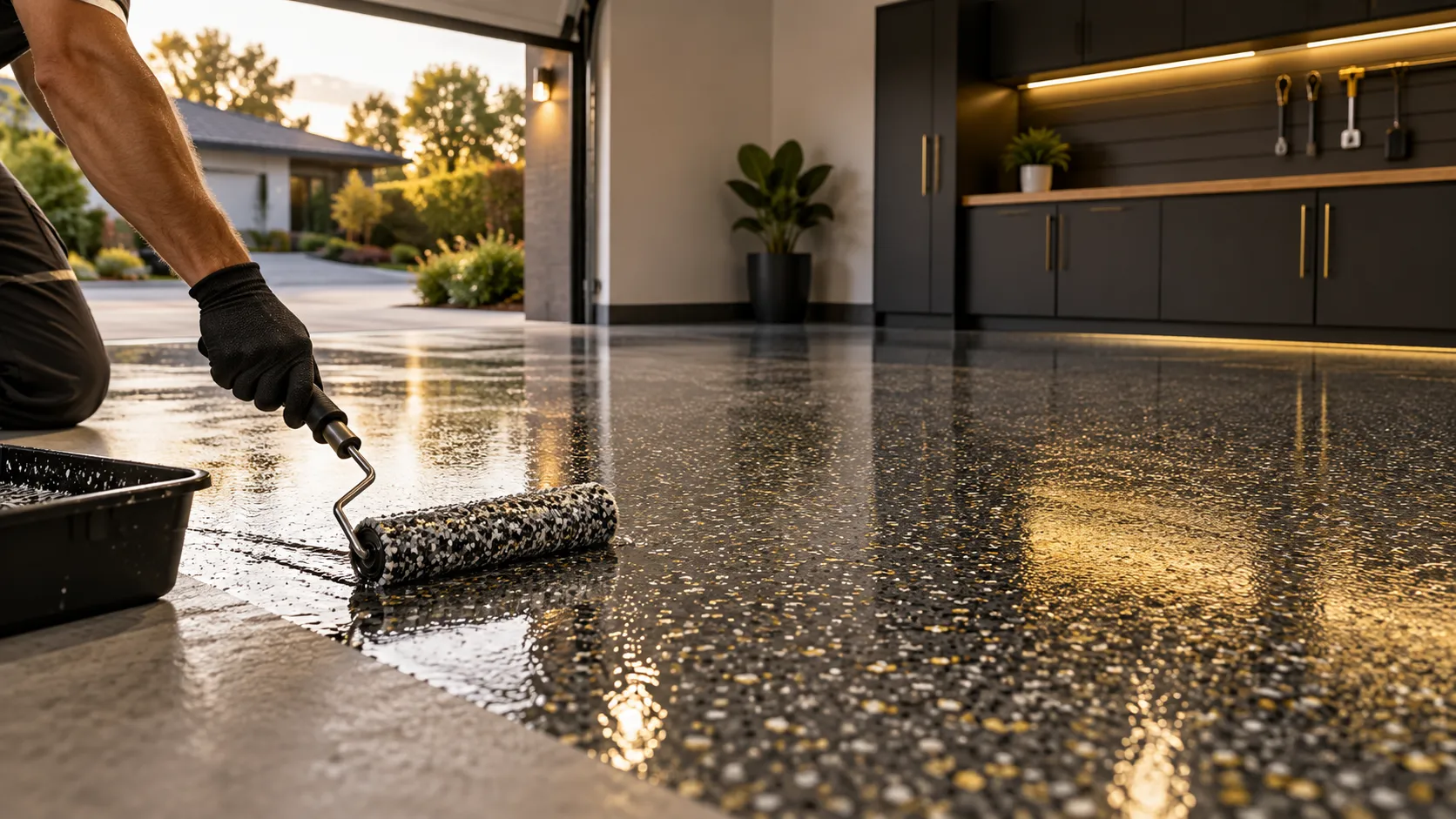
Full flake epoxy flooring uses decorative vinyl flakes broadcast across a coated base until the surface is heavily covered.
After curing, loose flakes are removed and the surface is scraped before a clear protective topcoat is applied.
Full flake systems are popular for:
- Garages
- Workshops
- Showrooms
- Utility areas
- Residential workspaces
The flakes provide colour variation and help visually disguise minor dirt, marks and day-to-day wear.
Different flake blends can also be used to coordinate the floor with walls, cabinetry or other finishes.
3. Metallic Epoxy Flooring
Metallic epoxy flooring uses metallic pigments manipulated within the resin to create flowing patterns, colour movement and visual depth.
No two metallic floors develop exactly the same pattern.
These systems are generally selected for appearance rather than heavy industrial performance. They are often used in:
- Residential interiors
- Retail spaces
- Studios
- Reception areas
- Showrooms
Metallic floors require careful application because mixing, movement, temperature and working time can affect the finished pattern.
4. Self-Levelling Epoxy Flooring
Self-levelling epoxy is a flow-applied resin flooring system designed to produce a smooth, continuous surface across suitably prepared concrete.
Despite the name, it does not automatically correct major slab defects. Cracks, holes, uneven areas and significant surface damage still need to be assessed and repaired before coating.
These systems are commonly used where a smooth, hygienic and easy-to-clean surface is required.
5. Anti-Slip Epoxy Flooring
Anti-slip epoxy flooring includes textured aggregate or other slip-resistant materials within the coating system.
Slip resistance can be adjusted according to the environment.
Higher texture may be useful around:
- Wet work areas
- Workshops
- Commercial kitchens
- Entry areas
- Service zones
- Outdoor covered spaces
However, increasing texture also affects cleaning. A heavily textured floor usually holds more soil than a smooth surface.
The correct finish therefore balances slip resistance with maintenance requirements.
6. Heavy-Duty Commercial and Industrial Epoxy Systems
Heavy-duty epoxy flooring uses higher-build or reinforced coating systems designed for demanding commercial and industrial environments.
These systems may need to tolerate:
- Forklift traffic
- Trolleys
- Machinery
- Vehicle movement
- Abrasion
- Oils
- Cleaning chemicals
- Repeated foot traffic
The floor specification should match the actual operating conditions. A light residential coating should not be expected to perform like an industrial system simply because both contain epoxy.
Where Is Epoxy Flooring Used?
Epoxy flooring is used wherever concrete needs greater protection, easier cleaning, improved appearance or a surface designed for specific traffic conditions.
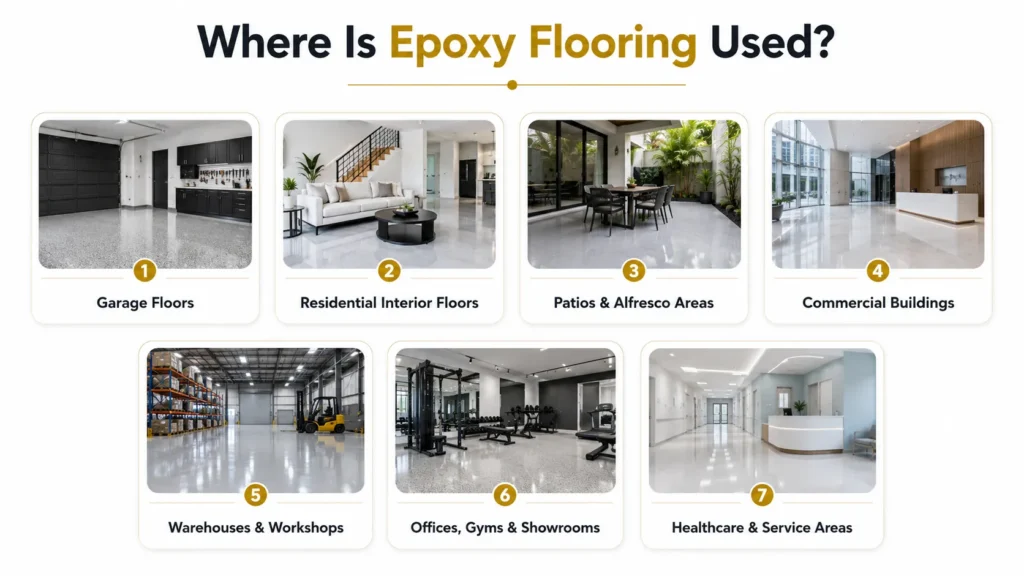
The appropriate system changes according to the environment.
Garage Floors
Garages are one of the most common applications for epoxy flooring.
A properly designed garage coating can protect concrete from:
- Vehicle traffic
- Tyre marks
- Oil
- Grease
- Dirt
- Workshop spills
- General abrasion
Full flake systems are particularly common because they combine durability with a decorative finish.
Garage floors also need careful preparation. Concrete contamination, old paint and weak surface material can reduce adhesion if they are not properly removed.
Residential Interior Floors
Epoxy can be used inside homes where homeowners want a seamless and low-joint flooring surface.
Applications may include:
- Utility rooms
- Home workshops
- Studios
- Converted garages
- Selected living areas
Decorative metallic and solid colour systems can create a more architectural finish.
The suitability of epoxy for interior living areas depends on appearance preferences, comfort expectations, substrate condition and the required finish.
Patios and Alfresco Areas
Epoxy and related resin coating systems can be used in some covered patios and alfresco spaces, but UV exposure must be considered before choosing the coating system.
Standard epoxy can discolour or chalk when exposed to prolonged ultraviolet light.
For areas exposed to Perth sunlight, the coating specification may need a UV-stable topcoat or another resin system better suited to exterior conditions.
Outdoor floors may also require added slip resistance where rain, pool water or cleaning creates wet surfaces.
Commercial Buildings
Commercial epoxy flooring is used in areas that require durable, presentable and easy-to-maintain concrete surfaces.
Common applications include:
- Retail areas
- Back-of-house spaces
- Service areas
- Storage rooms
- Commercial corridors
- Showrooms
The coating specification should consider customer traffic, equipment movement, cleaning methods and business downtime.
Warehouses and Workshops
Warehouses and workshops require flooring that can tolerate more demanding mechanical loads.
The system may need to resist:
- Forklifts
- Pallet movement
- Tool drops
- Oils
- Grease
- Tyre traffic
- Equipment vibration
- Repeated cleaning
Surface preparation is particularly important because existing warehouse slabs can contain oil contamination, previous coatings, cracks and heavily worn concrete.
Offices, Gyms and Showrooms
Epoxy flooring can provide a seamless, modern surface for customer-facing and activity-based commercial spaces.
Showrooms may prioritise visual appearance and cleanability.
Gyms may require resistance to foot traffic and equipment movement, although the flooring system must still be matched to expected impact loads.
Offices may use decorative epoxy in selected areas where a hard, continuous surface fits the interior design.
Healthcare and Service Areas
Resin flooring can be suitable for selected healthcare and service environments because a seamless surface reduces joints where soil can accumulate.
However, healthcare flooring requirements can be more complex than ordinary commercial flooring.
The selected system may need to account for:
- Cleaning chemicals
- Hygiene procedures
- Slip resistance
- Traffic levels
- Coving details
- Operational requirements
The flooring specification should therefore be based on the actual facility and its required standards.
What Are the Benefits of Epoxy Flooring?
Epoxy flooring can provide durability, stain resistance, easier cleaning, concrete protection and a wide range of decorative finishes when the system is correctly specified and installed.
Its main benefits depend on the coating system and operating environment.
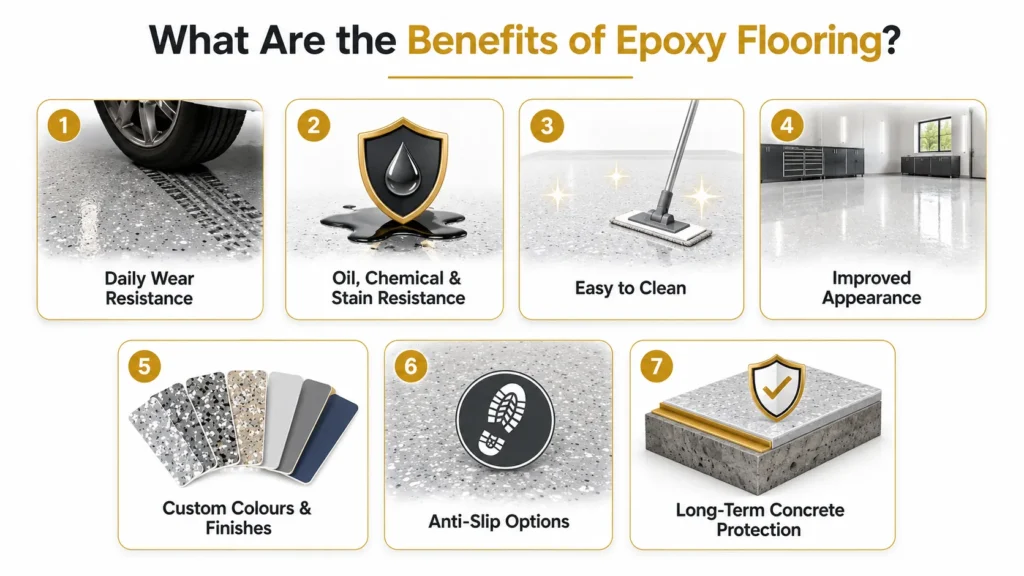
High Resistance to Daily Wear
A properly installed epoxy floor creates a hard surface that can tolerate regular foot traffic, vehicle movement and general abrasion.
Performance still depends on coating thickness, product selection and substrate preparation.
Heavy industrial traffic requires a more robust system than residential foot traffic.
Protection Against Oil, Chemicals and Stains
Epoxy surfaces can resist many common spills, including oils and workshop contaminants.
Chemical resistance is not universal, however.
Different resins respond differently to:
- Acids
- Alkalis
- Solvents
- Fuels
- Cleaning products
- Oils
Where chemical exposure is expected, the coating should be selected using the chemical-resistance information supplied for that specific product.
Spills should also be removed promptly rather than being allowed to remain on the floor.
Seamless and Easy-to-Clean Surface
Epoxy creates a continuous surface with very few joints.
This makes routine cleaning easier because dust and debris cannot collect in grout lines as they can with tiled floors.
Common maintenance usually involves:
- Sweeping
- Dust mopping
- Vacuuming
- Damp mopping
- Cleaning spills when they occur
The cleaning method should match the texture of the floor.
Improved Appearance of Existing Concrete
Epoxy can transform visually worn concrete by covering stains, colour variations and many repaired surface defects.
It can create a more finished appearance without removing the entire concrete slab.
However, epoxy does not make structural problems disappear. Movement cracks, moisture issues and unstable concrete must still be dealt with appropriately.
Custom Colours, Flakes and Finishes
Epoxy flooring can be customised using:
- Solid pigments
- Decorative flake blends
- Metallic pigments
- Clear finishes
- Matte or gloss effects
- Different aggregate textures
This allows the floor to be matched to residential interiors, workshops, commercial branding or functional requirements.
Anti-Slip Options for Different Environments
Slip-resistant aggregate can be incorporated where additional traction is required.
The amount and grade of aggregate should be selected according to the area.
For example, the required texture for a dry residential garage may differ from a wet commercial work zone.
More texture generally increases grip but can also make the floor more difficult to clean.
Long-Term Concrete Protection
Epoxy flooring forms a protective layer over the concrete substrate.
This can reduce direct exposure to:
- Vehicle fluids
- Dirt
- Surface abrasion
- Repeated cleaning
- General wear
Protecting the slab can also make future maintenance easier because contaminants remain on the coating instead of soaking directly into porous concrete.
What Are the Limitations of Epoxy Flooring?
Epoxy flooring performs well when correctly specified, but it is not suitable for every slab or every environment without proper assessment.
Understanding its limitations helps prevent coating failure.
Surface Preparation Determines Performance
Epoxy needs a suitable surface to bond correctly.
Applying a coating over smooth, contaminated, dusty or weak concrete can result in poor adhesion.
Professional preparation commonly involves mechanical grinding rather than relying only on acid washing or general cleaning.
The aim is to remove surface contamination and create a suitable profile for the coating system.
Moisture Can Affect Adhesion
Moisture moving through concrete can interfere with some resin coatings.
Potential problems include:
- Blistering
- Delamination
- Discolouration
- Loss of adhesion
Concrete that shows moisture concerns should be assessed before coating.
A coating should not be used as a substitute for diagnosing an underlying moisture problem.
Smooth Finishes Can Become Slippery When Wet
Smooth epoxy surfaces can become slippery when contaminated with:
- Water
- Oil
- Grease
- Cleaning solution
Slip-resistant aggregate can improve traction, but the required texture should be selected for the actual use of the area.
UV Exposure Can Affect Some Epoxy Systems
Many standard epoxy resins can yellow, fade or chalk after prolonged UV exposure.
This is particularly relevant in Perth, where outdoor and partially exposed floors can receive intense sunlight.
Exterior areas may therefore require a UV-stable topcoat or a coating chemistry better suited to prolonged sunlight.
Installation Requires Curing and Downtime
Epoxy does not become fully usable immediately after application.
Each layer needs adequate curing time before the next stage or before normal traffic resumes.
Temperature, product chemistry, coating thickness and site conditions all influence curing.
Premature traffic can mark or damage a floor before it has reached the required strength.
How Is Epoxy Flooring Installed?
Epoxy flooring is installed by inspecting and mechanically preparing the concrete, repairing defects, applying the specified coating layers and allowing the system to cure before use.
Correct installation is more involved than simply rolling epoxy over existing concrete.
Inspect the Existing Concrete
Installation starts with an assessment of the slab.
The installer should look for:
- Cracks
- Surface contamination
- Oil
- Existing coatings
- Weak concrete
- Moisture concerns
- Joints
- Repairs
- Surface unevenness
This inspection helps determine the required preparation and coating system.
Remove Existing Coatings and Contamination
Old paint, sealers and failed coatings must usually be removed before the new system is installed.
Oil and grease contamination also need attention.
Coating over an unsuitable existing surface simply transfers the adhesion risk to the new floor.
Diamond Grind the Concrete Surface
Mechanical diamond grinding removes weak surface material and exposes clean concrete.
Grinding can also:
- Remove previous coatings
- Reduce surface contamination
- Open the concrete surface
- Create a more consistent profile
The purpose is to provide the new resin system with a suitable substrate to bond to.
At Apex Epoxy Perth, professional surface preparation is treated as a core part of the flooring system rather than an optional step.
Repair Cracks, Joints and Surface Damage
Visible defects should be addressed before coating.
Repairs can include:
- Crack filling
- Spall repairs
- Edge repairs
- Localised patching
- Joint treatment
Not every crack should be treated in exactly the same way.
Static surface cracks and moving structural joints behave differently. A rigid coating cannot permanently stop structural slab movement.
Apply the Base or Primer Coat
A primer or base coat is applied according to the selected system.
This layer helps establish adhesion and provides the foundation for subsequent coats.
The correct application rate and recoat window depend on the product.
Apply the Epoxy Build Coats or Flake System
The main coating layers are then applied.
For a solid colour system, this may involve one or more pigmented build coats.
For a flake system, decorative flakes are broadcast into the wet base coat.
The amount of material used affects thickness, coverage and appearance.
Scrape and Prepare the Flake Surface
Once a full flake layer has cured, excess flakes are removed.
The surface is then scraped to knock down raised edges and create a more consistent texture before the clear coat is applied.
This step affects both appearance and how the topcoat sits across the floor.
Apply the Protective Topcoat
The final topcoat protects the decorative or epoxy layers beneath it.
Depending on the project, the topcoat may be selected for:
- Abrasion resistance
- Chemical resistance
- UV stability
- Gloss level
- Slip resistance
For exposed Perth environments, UV performance is an important consideration.
Apex Epoxy Perth uses coating systems from Australian suppliers such as APC and Shimicoat depending on project requirements.
Allow the Floor to Cure Before Use
The completed coating must cure before normal use resumes.
Light foot traffic may be permitted before vehicle or equipment traffic, but the exact timing depends on the coating system.
Always follow the product-specific curing requirements rather than assuming every epoxy floor has the same reopening time.
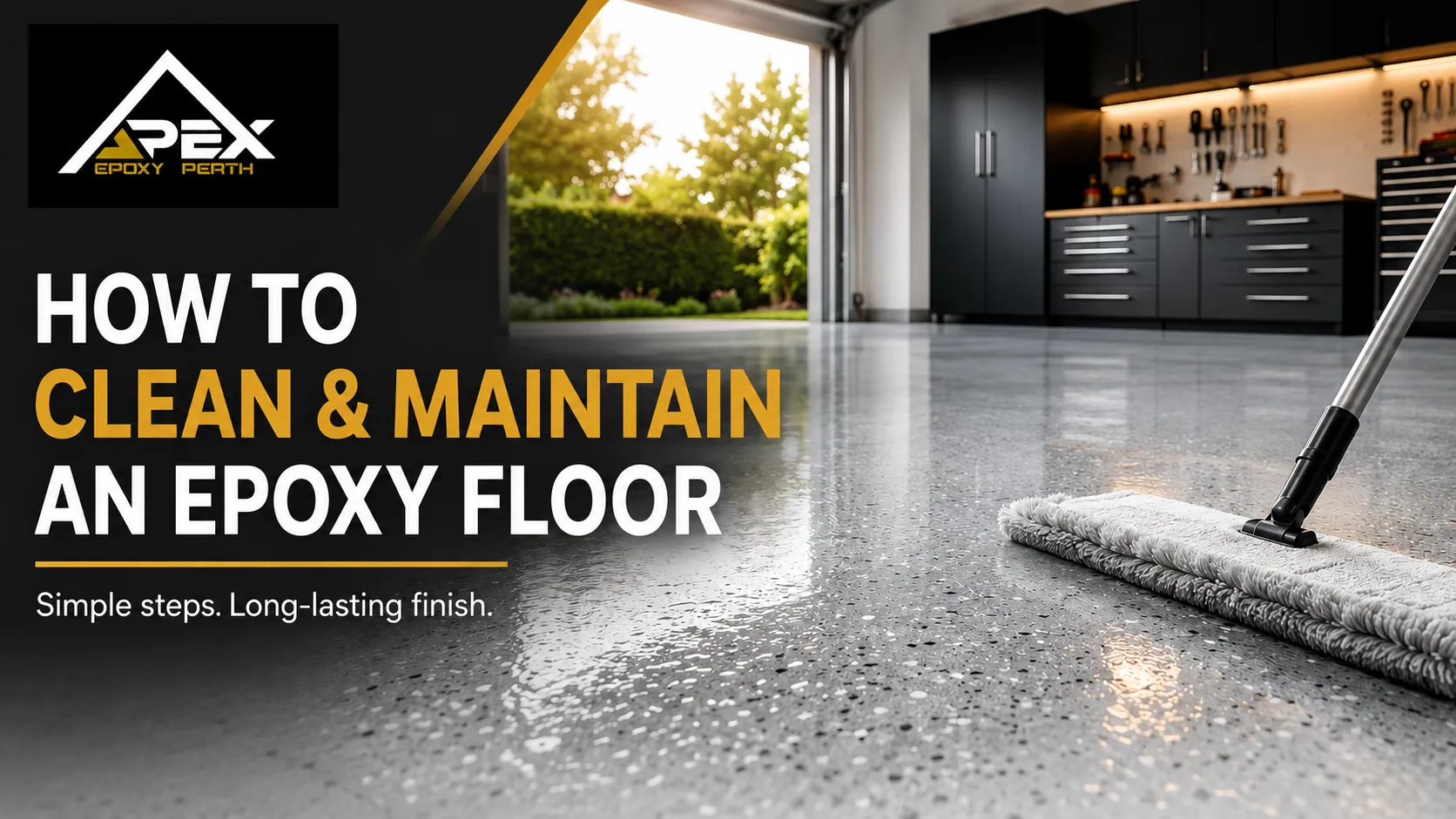
How Do You Clean and Maintain Epoxy Flooring?
Epoxy flooring is maintained by regularly removing abrasive dirt, cleaning spills promptly and using cleaning products that are compatible with the coating.
Good maintenance helps preserve both the appearance and protective surface.
Routine Dust and Dirt Removal
Loose dirt can act as an abrasive when people, tyres or equipment move across the floor.
Routine cleaning may include:
- Sweeping
- Soft-bristle broom cleaning
- Dust mopping
- Vacuuming
High-traffic commercial floors normally require more frequent cleaning than residential garages.
Cleaning Oil, Grease and Spills
Oil, grease and other spills should be removed as soon as practical.
A suitable degreaser or neutral cleaning solution can be used when compatible with the coating.
Allowing contamination to remain on the floor can increase slipping risks and make later cleaning more difficult.
Avoiding Abrasive or Unsuitable Cleaners
Harsh chemicals should not automatically be used simply because epoxy is described as chemical resistant.
Avoid cleaners that are unsuitable for the installed topcoat.
Aggressive scouring pads and highly abrasive cleaning methods can also dull the surface over time.
Follow the coating manufacturer’s maintenance guidance where available.
Repairing Localised Damage
Small damaged areas may sometimes be repaired without recoating the entire floor.
Repair options depend on:
- Depth of damage
- Size of the affected area
- Coating system
- Colour
- Existing wear
- Cause of failure
Damage caused by substrate movement or moisture should be investigated before simply recoating the affected area.
How Much Does Epoxy Flooring Cost?
Epoxy flooring cost is normally determined by the floor area, concrete condition, preparation requirements, coating system, repairs and site access rather than by one fixed rate.
Two floors of the same size can require very different amounts of labour and material.
Important cost factors include:
| Cost Factor | Why It Changes the Price |
| Floor area | Larger areas require more coating and labour |
| Existing coatings | Removal adds preparation time |
| Concrete condition | Damaged slabs may need extensive repairs |
| Oil contamination | Additional cleaning or grinding may be required |
| Coating system | Solid, flake and heavy-duty systems use different materials |
| Number of layers | Higher-build systems require more product |
| Topcoat | UV-stable or specialist topcoats can change system cost |
| Slip resistance | Aggregate and additional application stages may be required |
| Access | Difficult access can increase labour requirements |
| Operational restrictions | Staged or after-hours commercial work can affect installation planning |
The cheapest quote is therefore not automatically the lowest-cost floor over its service life.
Compare what is included in the preparation, repair, coating thickness and topcoat rather than comparing only the final figure.
For Perth properties, a site inspection is often the most accurate way to assess the slab and determine the appropriate system.
How to Choose the Right Epoxy Flooring System
Choose an epoxy flooring system by matching its preparation method, coating build, texture and topcoat to the traffic, environment and appearance required from the floor.
Start with how the space will actually be used.
Consider these factors:
- Traffic type: Foot traffic, cars, forklifts and machinery create different demands.
- Concrete condition: Cracks, contamination and existing coatings affect preparation.
- UV exposure: Outdoor and partially exposed areas require suitable UV protection.
- Chemical exposure: Workshops and industrial areas may need higher chemical resistance.
- Slip resistance: Wet or contaminated areas may require aggregate.
- Appearance: Solid colours, full flakes and metallic finishes create different visual results.
- Maintenance: Heavily textured floors can require more cleaning effort.
- Downtime: Commercial projects may need a system that fits operational schedules.
A simple comparison can help:
| Area | Common Priority | Suitable System Direction |
| Residential garage | Vehicle traffic, appearance, easy cleaning | Full flake or durable solid system |
| Workshop | Oil, abrasion, tools | Heavy-duty epoxy with suitable topcoat |
| Warehouse | Equipment and repeated traffic | Commercial or industrial high-build system |
| Showroom | Appearance and cleanability | Decorative solid, flake or selected resin finish |
| Alfresco area | UV and slip resistance | Exterior-suitable resin system with UV-stable protection |
| Interior decorative area | Visual design | Metallic or decorative epoxy system |
The final specification should be based on the slab and operating conditions rather than selecting a system from appearance alone.
What Should You Look for in an Epoxy Flooring Installer?
A suitable epoxy flooring installer should be able to explain the preparation process, assess the concrete, specify the coating system and clearly state what is included in the installation.
Look beyond photos of completed floors.
Important questions include:
- How will the concrete be prepared?
- Will the surface be mechanically ground?
- How are cracks and damaged areas treated?
- How will existing coatings be removed?
- What coating products will be used?
- Is the system suitable for UV exposure?
- What level of slip resistance will be provided?
- How many coating stages are included?
- When can the floor return to service?
- What workmanship warranty is provided?
Surface preparation deserves particular attention. A visually attractive topcoat cannot compensate for poor adhesion underneath.
Apex Epoxy Perth uses professional surface preparation, crack and joint repairs and project-specific coating systems, with workmanship backed by a 5-year workmanship warranty.
Frequently Asked Questions About Epoxy Flooring
Why Is Concrete Surface Preparation Important for Epoxy Flooring?
Surface preparation improves epoxy adhesion by removing weak concrete, contamination and existing coatings. Diamond grinding also creates the surface profile needed for a stronger bond.
How Durable Is Epoxy Flooring?
Epoxy flooring is highly resistant to abrasion, foot traffic, vehicles, oils and general wear when the correct system is installed over properly prepared concrete.
How Long Does Epoxy Flooring Last?
Epoxy flooring lifespan depends on surface preparation, coating thickness, traffic, UV exposure and maintenance. Residential floors generally experience less wear than commercial or industrial floors.
Is Epoxy Flooring Waterproof?
Epoxy flooring creates a water-resistant, low-permeability surface, but it is not automatically a certified waterproofing membrane. Cracks, joints and penetrations can still allow moisture movement.
Is Epoxy Flooring Slippery?
Smooth epoxy can become slippery when wet. Anti-slip aggregates can be added to increase surface grip in garages, workshops, commercial areas and other wet environments.
Can Epoxy Flooring Be Used Outdoors?
Epoxy flooring can be used in some outdoor areas, but standard epoxy can discolour under prolonged UV exposure. Exterior areas generally require a UV-stable protective coating system.
Can Epoxy Flooring Be Applied Over Cracked or Damaged Concrete?
Yes. Cracks and damaged concrete can often be repaired before epoxy installation. Active structural cracks or slab movement should be assessed before coating.
Can Epoxy Flooring Be Applied Over Existing Paint or Coatings?
Yes, but only when the existing coating is sound, compatible and properly bonded. Failed paint or coatings should normally be mechanically removed before epoxy is applied.
How Long Does Epoxy Flooring Take to Dry and Cure?
Curing time varies by product and conditions. Light foot traffic may be possible before vehicle traffic or full chemical cure, so the manufacturer’s specified curing times should always be followed.
Final Thoughts
Epoxy flooring is more than a coloured coating applied over concrete. It is a complete flooring system in which concrete preparation, repairs, resin layers, decorative materials and protective topcoats work together.
The most important decision is not simply choosing between grey, flakes or metallic effects. The floor must first be designed for the substrate and the way the space will be used.
For garages, this may mean vehicle resistance and easy cleaning. Warehouses may require higher abrasion resistance and stronger coating builds. Outdoor Perth areas need careful consideration of UV exposure and slip resistance.
Correct preparation remains the foundation of every successful installation. Grinding, repairing and assessing the concrete before coating gives the flooring system the best opportunity to bond and perform as intended.
Apex Epoxy Perth follows this process-driven approach across residential and commercial flooring projects in Perth, using project-specific coating systems and backing workmanship with a 5-year workmanship warranty.