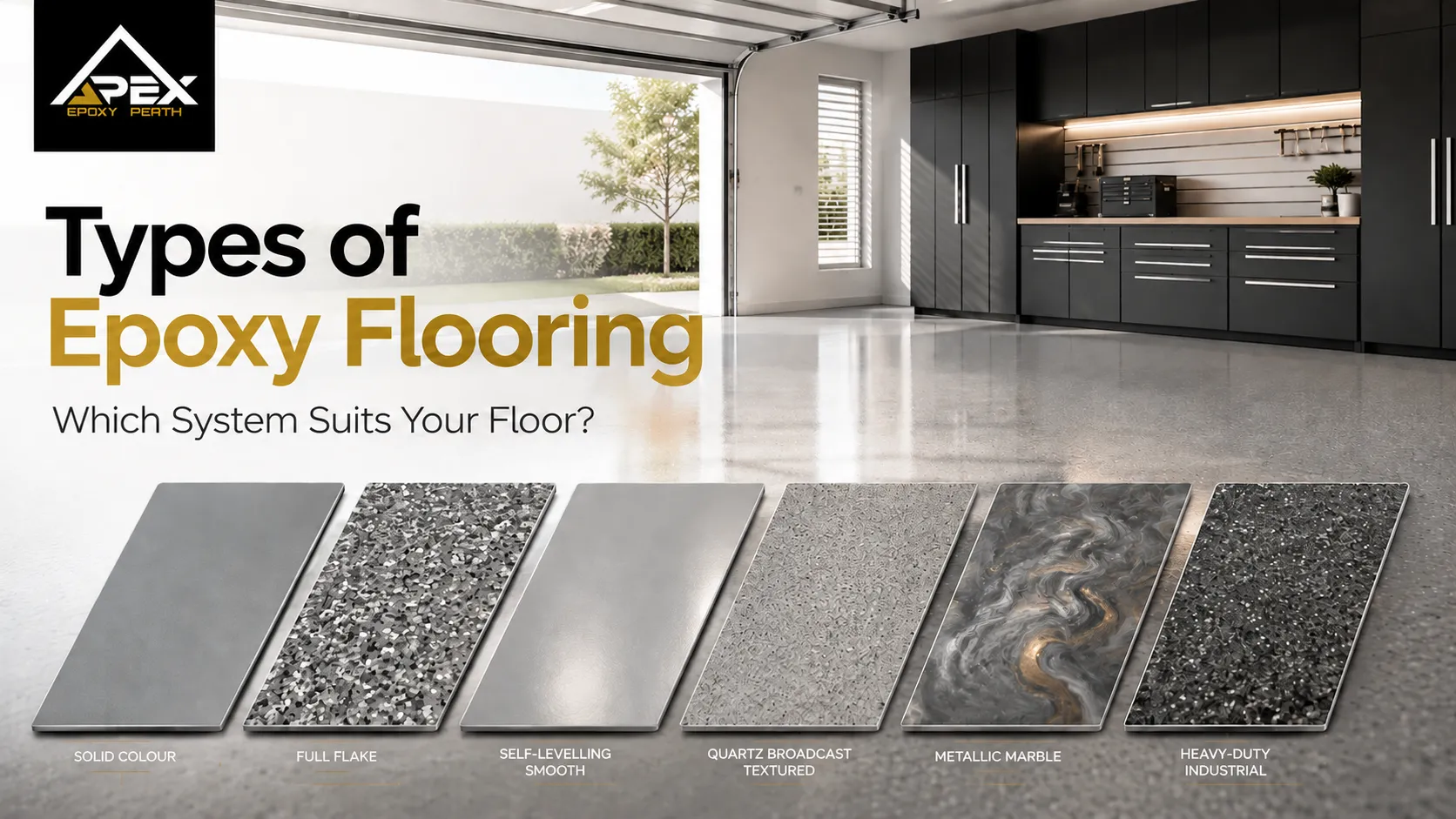

Epoxy flooring is not one single product or finish. It is a floor coating system built around the condition of the concrete, expected traffic, exposure to water, oils, chemicals, sunlight, and the required appearance.
A smooth decorative floor, a full-flake garage floor, and a heavy-duty warehouse floor may all use epoxy, but they need different preparation, build thickness, aggregates, and protective topcoats.
Selecting the right system matters because an epoxy coating cannot compensate for unresolved moisture, active slab movement, poor preparation, or a finish that is unsuitable for the area.
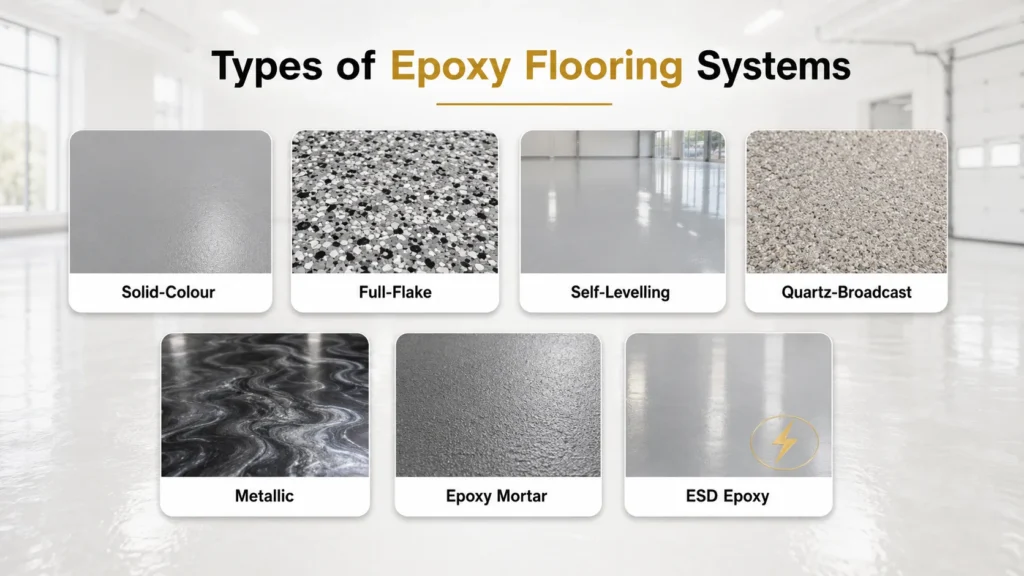
Types of Epoxy Flooring Systems
The main epoxy flooring systems differ in appearance, thickness, texture, and performance.
| System | Main finish | Common uses | Key consideration |
| Solid-colour epoxy | Smooth, single-colour surface | Warehouses, workshops, retail, garages | Texture may be needed for wet areas |
| Full-flake epoxy | Decorative vinyl flakes under clear topcoat | Garages, workshops, showrooms, patios | Requires a suitable UV-stable topcoat where exposed to sun |
| Self-levelling epoxy | Smooth, seamless, high-build finish | Offices, showrooms, indoor commercial areas | Does not correct major slab falls or structural damage |
| Quartz-broadcast epoxy | Coloured quartz aggregate finish | Wet commercial areas, amenities, high-wear spaces | Texture and colour blend must suit cleaning and safety needs |
| Metallic epoxy | Marbled or flowing decorative effect | Indoor residential floors, showrooms, feature spaces | Appearance varies with application and is less practical for harsh areas |
| Epoxy mortar or screed | Thick, aggregate-filled industrial surface | Warehouses, factories, repair zones | Designed and installed for specific loads and conditions |
| ESD epoxy | Conductive or static-dissipative surface | Electronics and controlled production areas | Requires defined electrical-performance requirements |
1. Solid-Colour Epoxy Flooring
Solid-colour epoxy flooring is a seamless coating system finished in one consistent colour, such as grey, charcoal, white, blue, or a custom commercial colour. It is commonly specified where a clean, practical floor is more important than a decorative pattern.
A solid-colour system can be applied as a thinner protective coating or as a higher-build system, depending on the slab condition and expected use.
It is suitable for garages, workshops, storage areas, warehouses, retail back-of-house spaces, and some commercial floors.
Its main advantages are a uniform appearance, easy cleaning, and a finish that can be colour-coded for work zones, walkways, or safety areas. However, smooth solid-colour epoxy can become slippery when water, oil, or detergent is present. Anti-slip aggregate should be added where the area is regularly wet or exposed to spills.
2. Full-Flake Epoxy Flooring
Full-flake epoxy flooring uses coloured vinyl flakes broadcast across a pigmented epoxy base coat, then sealed beneath one or more clear topcoats.
The result is a speckled, stone-like finish that hides dust, tyre marks, small imperfections, and everyday wear better than a plain colour.
Full-flake systems are a popular choice for:
- Residential garages
- Home workshops
- Showrooms
- Retail spaces
- Alfresco areas
- Covered patios
- Light commercial floors
The flake layer adds visual depth and can provide a lightly textured feel, but it is not automatically slip-resistant in every condition. The final traction depends on the flake coverage, topcoat, and any added anti-slip media.
For sun-exposed areas, the system should include a UV-stable topcoat. Epoxy alone can amber or lose gloss under prolonged UV exposure, especially in Perth’s strong sunlight.
3. Self-Levelling Epoxy Flooring
Self-levelling epoxy flooring is a high-build resin system that flows across a prepared concrete slab to create a smooth, seamless surface. It is used where a refined appearance, easy cleaning, and a more even finish are required.
It is commonly suited to:
- Indoor residential rooms
- Retail floors
- Offices
- Showrooms
- Medical or clean work areas
- Light industrial spaces
Self-levelling epoxy can cover minor surface texture, shallow imperfections, and small areas of unevenness. It does not fix major concrete movement, deep cracking, drainage falls, or structural slab problems. Those issues need repair or separate levelling work before the coating system is installed.
A self-levelling finish is usually smooth, so it is best for dry indoor environments unless a suitable traction additive is specified.
4. Quartz-Broadcast Epoxy Flooring
Quartz-broadcast epoxy flooring contains coloured quartz aggregate embedded into epoxy resin and sealed with protective coats. The quartz creates a durable, textured surface that can provide better grip and wear resistance than a smooth epoxy finish.
Quartz systems are often used in areas that need durability, cleanability, and a more safety-focused finish, including:
- Commercial kitchens
- Change rooms
- Bathrooms and amenities
- Medical facilities
- Schools
- Retail entrances
- Light industrial work areas
The amount, size, and colour blend of quartz can be adjusted to suit the area. A more aggressive texture may improve traction but can also make the floor harder to clean. The system should balance slip resistance with the maintenance requirements of the space.
5. Metallic Epoxy Flooring
Metallic epoxy flooring uses metallic pigments within clear or coloured epoxy to create marbled, clouded, flowing, or three-dimensional visual effects. Every installation has variation because the pattern develops during application.
Metallic epoxy is best suited to indoor spaces where appearance is a major priority, such as:
- Feature rooms
- Residential interiors
- Reception areas
- Showrooms
- Retail spaces
- Studios
- Display floors
It is not usually the first choice for industrial workspaces, outdoor surfaces, or areas with frequent grit, heavy impacts, standing water, or aggressive chemical exposure. A quality clear topcoat helps protect the decorative layer from scratching and wear.
6. Epoxy Mortar and Heavy-Duty Screed Flooring
Epoxy mortar and heavy-duty screed systems combine epoxy resin with a high proportion of graded aggregate. This creates a thicker, denser floor designed for higher impact, abrasion, and load requirements than a standard coating.
These systems may be specified for:
- Warehouses
- Manufacturing facilities
- Mechanical workshops
- Loading areas
- Plant rooms
- Forklift routes
- Damaged concrete requiring substantial rebuilding
Epoxy mortar does not flow like a self-levelling system. It is placed, compacted, and finished by trained installers. It can repair worn, pitted, or broken concrete while creating a durable base for a final protective coating.
The required thickness should be determined by the condition of the slab, the type of equipment used, wheel loads, impact exposure, and cleaning methods.
7. ESD and Anti-Static Epoxy Flooring
ESD epoxy flooring is a specialist resin system designed to control static electricity. “ESD” means electrostatic discharge. These floors are used where static charges can damage sensitive electronics, affect production processes, or create safety risks.
Typical applications include:
- Electronics manufacturing
- Server rooms
- Laboratories
- Cleanrooms
- Medical equipment areas
- Assembly zones handling sensitive components
An ESD floor is not simply standard epoxy with a different colour. It may require conductive layers, grounding points, conductive materials, and post-installation electrical testing.
The required resistance range should be set by the facility, equipment manufacturer, or project specification before the system is selected.
Epoxy Formulations That Affect Floor Performance
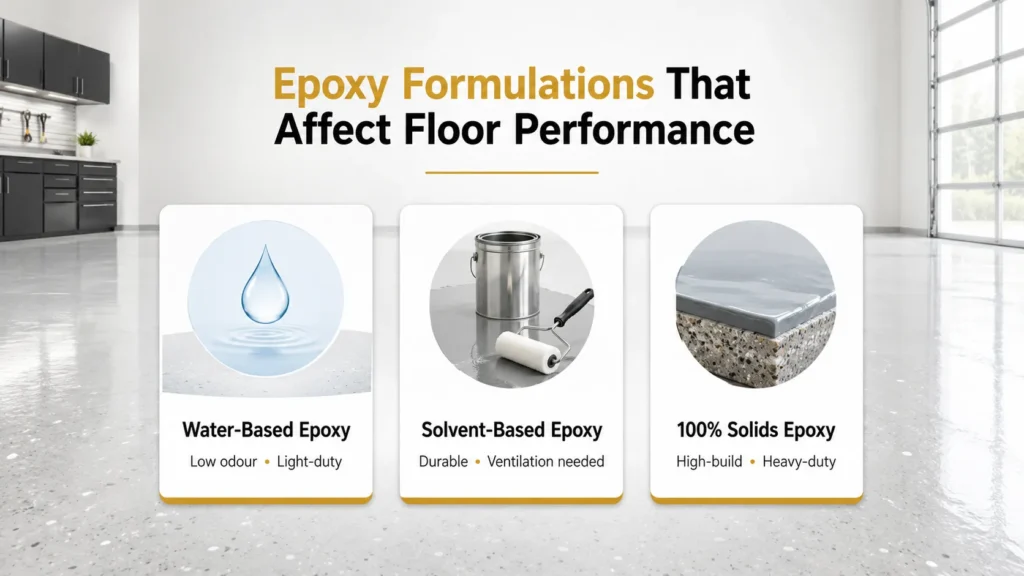
The system type describes the finished floor. The epoxy formulation describes the coating material used to build that system. Formulation affects film build, curing behaviour, odour, application conditions, and durability.
Water-Based Epoxy
Water-based epoxy uses water as a carrier. It is commonly used for lighter-duty protective coatings and areas where lower odour during application is important.
Water-based epoxy may suit low-traffic residential or light commercial floors when the concrete is sound and the performance requirement is modest. It generally forms a thinner dry film than high-build systems and may require several coats to achieve the required coverage.
It is usually not the preferred option for heavily used garages, workshops, warehouses, or floors exposed to regular vehicle traffic, chemicals, and impact.
Solvent-Based Epoxy
Solvent-based epoxy uses solvents that evaporate as the coating cures. These systems can provide a durable finish and have historically been used in industrial and commercial applications.
The main consideration is application safety. Solvent-containing coatings may require ventilation, controlled ignition sources, appropriate PPE, and compliance with the product safety data sheet. The final performance depends on the specific product, thickness, surface preparation, and topcoat.
Solvent-based epoxy should be selected by system requirements, not simply because it is easier to roll onto a floor.
100% Solids Epoxy
100% solids epoxy contains no evaporating solvent or water carrier. It cures through a chemical reaction between resin and hardener, allowing a thicker dry film to be installed in fewer coats.
This makes 100% solids epoxy suitable for higher-build coatings, full-flake systems, self-levelling floors, and demanding commercial or industrial applications. It is commonly chosen where stronger protection, better build thickness, and longer-term performance are required.
Its short working time and application sensitivity make proper mixing, temperature control, and installation technique important. A 100% solids product is not automatically the correct choice for every floor. The slab condition, exposure, and required finish still determine the system.
Performance Features That Can Be Added to an Epoxy System
An epoxy floor can be adapted with primers, repair materials, aggregates, and topcoats. These components often determine whether a floor performs well in its actual environment.
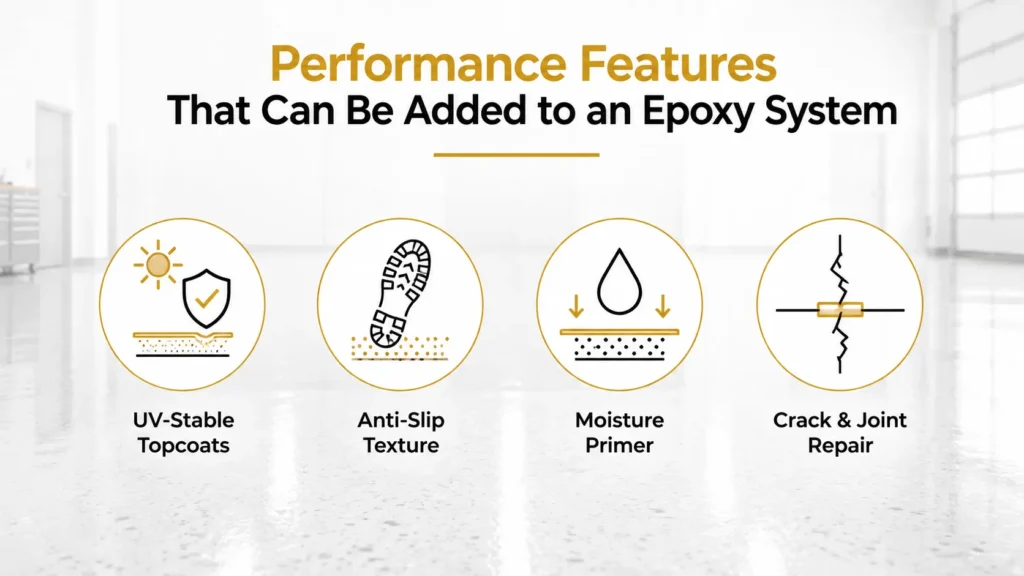
UV-Stable Polyaspartic or Polyurethane Topcoats
Polyaspartic and polyurethane topcoats protect epoxy from UV exposure, surface abrasion, staining, and loss of gloss. They are particularly important for floors exposed to direct sunlight, such as garages with open doors, patios, alfresco areas, driveways, and pool surrounds.
Epoxy provides strong adhesion and build properties, but it is not naturally the most UV-stable resin. A UV-stable topcoat helps protect the system from yellowing, chalking, and premature weathering.
The topcoat must be matched to the base system, exposure conditions, and required cure time. It should not be treated as a substitute for proper concrete preparation or moisture control.
Anti-Slip Aggregates and Textured Finishes
Anti-slip aggregates increase traction by creating texture in the final surface. They can be added to clear or coloured topcoats and are useful where water, oil, cleaning products, or wet footwear are likely.
They are commonly considered for:
- Pool surrounds
- Alfresco areas
- Driveways
- Workshops
- Commercial kitchens
- Entry areas
- Wash bays
- Outdoor walkways
More texture can improve grip, but it can also hold more dirt and require more thorough cleaning. The correct level of texture depends on whether the floor is used by barefoot people, pedestrians, trolleys, vehicles, or machinery.
Moisture-Mitigation Primers
Moisture-mitigation primers are designed to manage certain levels of moisture vapour transmission from the concrete slab. They may be used where testing identifies moisture conditions that could affect epoxy adhesion.
A moisture primer is not a universal fix for every damp slab. Standing water, hydrostatic pressure, drainage problems, rising damp, or structural moisture issues may require separate investigation before any coating system is applied.
Concrete moisture should be assessed before specifying epoxy. Applying a coating over an unsuitable slab can lead to bubbling, delamination, whitening, or peeling.
Crack Repairs, Joint Treatment, and Flexible Details
Cracks, spalls, holes, and damaged concrete need repair before epoxy is installed. The repair method depends on whether the defect is static, structural, cosmetic, or caused by continuing slab movement.
Static cracks can often be cleaned, filled, and ground flush before coating. Expansion joints and movement joints require different treatment because they are designed to move.
Coating rigid epoxy across an active joint can cause the crack or joint line to reappear through the finish.
A proper assessment separates:
- Surface cracks
- Static shrinkage cracks
- Active movement cracks
- Construction joints
- Expansion joints
- Concrete spalling and delamination
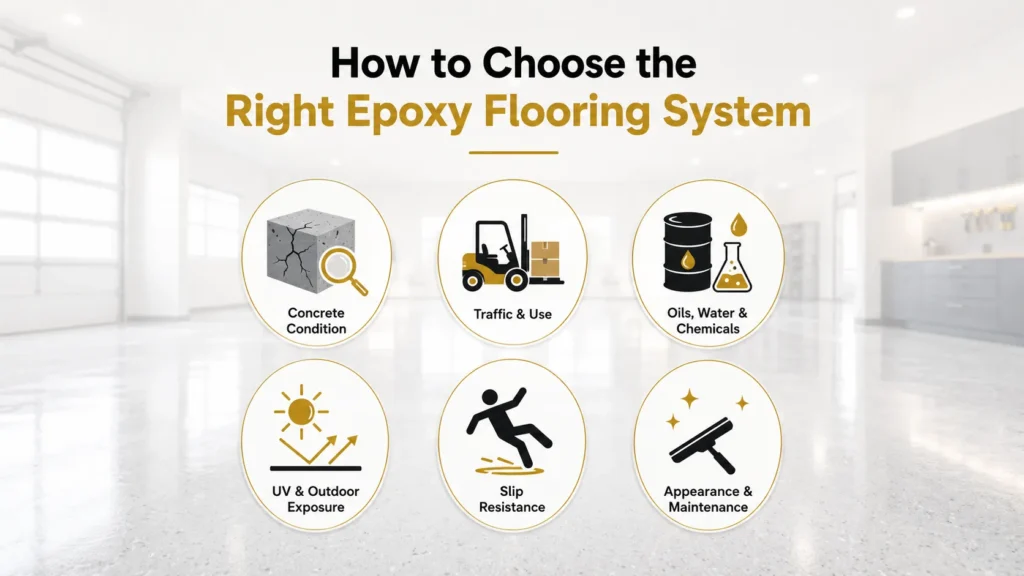
How to Choose the Right Epoxy Flooring System
The right epoxy flooring system starts with how the floor is used, not with colour or finish selection.
Assess the Condition of the Concrete Slab
Concrete condition determines the amount of preparation and repair needed before coating. A sound slab with minor staining needs a different approach from concrete with oil contamination, failed paint, cracks, moisture issues, or surface damage.
A site assessment should identify:
- Existing coatings and sealers
- Oil, grease, tyre residue, or chemical contamination
- Surface hardness and porosity
- Cracks, joints, pits, and spalling
- Moisture conditions
- Drainage falls
- Areas affected by sunlight or weather
Diamond grinding is commonly used to remove weak surface material, old coatings, and contaminants while creating a surface profile for the epoxy to bond to.
Match the System to Foot Traffic, Vehicles, and Equipment
Traffic determines the required build thickness, aggregate loading, abrasion resistance, and topcoat performance. A floor used by pedestrians has different demands from a garage floor, forklift route, or mechanical workshop.
| Floor use | Typical system direction |
| Light foot traffic | Thin-build solid-colour or decorative epoxy |
| Residential garage | Full-flake or solid-colour system with durable clear topcoat |
| Home workshop | Full-flake or solid-colour system with added texture where needed |
| Retail or showroom | Self-levelling, solid-colour, flake, or metallic system |
| Warehouse and workshop | High-build solid-colour, quartz, mortar, or screed system |
| Heavy machinery or forklifts | Specified high-build or mortar system based on load and impact |
The system should be selected for the highest likely demand, not only normal daily use.
Consider Oils, Chemicals, Water, and Cleaning Requirements
Different areas are exposed to different spills. Garages and workshops may need resistance to oils, fuels, brake fluid, and tyre marks. Commercial facilities may require resistance to detergents, food residues, cleaning chemicals, or industrial materials.
The final system should consider:
- Type and frequency of spills
- How quickly spills are cleaned
- Whether hot materials contact the floor
- Cleaning products and scrubber use
- Required hygiene standard
- Whether water pools on the surface
Chemical resistance is product-specific. A coating that performs well against vehicle oil may not be suitable for strong acids, solvents, hot washdown conditions, or thermal shock.
Account for Sunlight, Heat, and Outdoor Exposure
Sunlight and heat can change how an epoxy floor looks and performs over time. Direct UV exposure can cause standard epoxy to amber, chalk, or lose gloss.
Outdoor and sunlit areas should be assessed for:
- Daily sun exposure
- Surface temperature
- Rain and standing water
- Drainage
- Barefoot use
- Vehicle traffic
- Heat from tyres or equipment
A UV-stable polyaspartic or polyurethane topcoat is commonly used where sunlight is a factor. In Perth, this is particularly important for open garages, patios, driveways, pool surrounds, and outdoor entertaining areas.
Choose the Right Level of Slip Resistance
Slip resistance should be matched to how the floor is used when wet, oily, dusty, or cleaned. A smooth decorative finish may suit a dry showroom, while a pool surround or workshop usually needs more texture.
Consider who uses the area and under what conditions:
- Bare feet near pools
- Wet shoes at entries
- Oily footwear in workshops
- Vehicle tyres in garages
- Trolleys and wheeled equipment
- Cleaning and washdown procedures
The safest option is not always the roughest option. Excessive texture can make cleaning difficult and may not suit wheeled traffic. The system should provide practical traction without creating an unnecessarily hard-to-maintain surface.
Balance Appearance, Maintenance, and Long-Term Wear
The finish should suit the floor’s purpose. Full-flake systems disguise dirt and light wear well, making them practical for garages and workshops. Solid-colour epoxy creates a clean, uniform look that suits commercial spaces. Metallic epoxy creates a feature finish but needs a protected indoor environment.
When comparing options, consider:
- How visible dust and tyre marks will be
- Whether repairs need to blend into the finish
- Cleaning time and equipment
- Colour choice and lighting
- Expected wear pattern
- Whether the area is functional, decorative, or both
A floor that looks impressive on installation day should also be practical to clean and maintain after years of use.
Plan Around Installation and Cure Time
Epoxy installation involves preparation, repairs, primer application, base coats, decorative layers, topcoats, and curing. The schedule depends on the system, slab condition, weather, temperature, and access requirements.
Before installation, confirm:
- When the area must be closed
- When foot traffic can return
- When vehicles or equipment can return
- Whether work needs to be staged
- Whether adjacent trades or operations affect the coating
- Whether after-hours or weekend installation is needed
Rushing cure time can damage a new coating before it reaches its intended performance.
Which Epoxy System Suits Each Area?
The best system depends on the actual conditions of the floor. These are practical starting points, not replacements for a slab assessment.
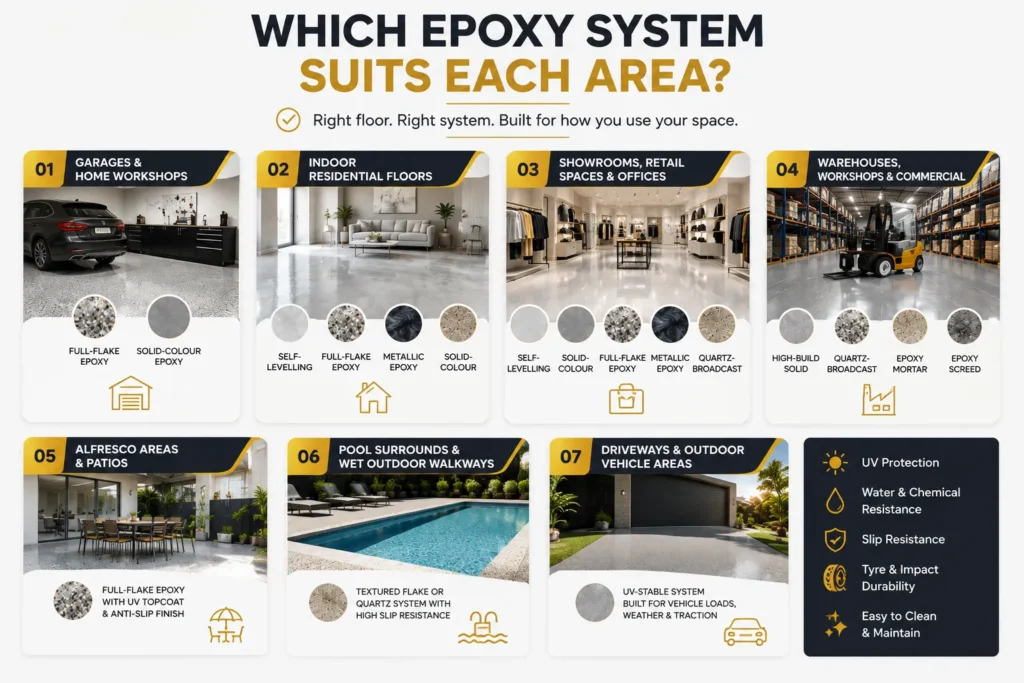
Garages and Home Workshops
Full-flake epoxy flooring is often the most practical choice for garages and home workshops. It creates a durable decorative finish, hides dust and minor marks, and can be sealed with a hard-wearing, UV-stable topcoat.
Solid-colour epoxy can also suit garages that need a clean, simple appearance. For workshops, anti-slip texture should be considered where oil, water, or wet footwear is possible.
The slab should be diamond-ground, cracks repaired, and existing failed paint removed before coating.
Indoor Residential Floors
Self-levelling epoxy, full-flake epoxy, solid-colour epoxy, and metallic epoxy can all suit indoor residential floors. The right choice depends on whether the area is mainly functional or decorative.
Metallic epoxy suits feature spaces where a unique visual effect is the priority. Self-levelling or solid-colour epoxy suits modern, seamless interiors. Full-flake epoxy works well in utility rooms, laundries, garages, and practical indoor spaces where durability matters more than a smooth designer finish.
Showrooms, Retail Spaces, and Offices
Showrooms, retail spaces, and offices often need a finish that is durable, clean, and visually consistent with the brand or interior design.
Suitable options include:
- Self-levelling epoxy for a smooth, seamless appearance
- Solid-colour epoxy for a uniform commercial finish
- Full-flake epoxy for practical decorative durability
- Metallic epoxy for feature areas and display zones
- Quartz-broadcast epoxy for areas needing more traction
The system should account for foot traffic, entrance moisture, display equipment, cleaning routines, and the visual effect under lighting.
Warehouses, Workshops, and Commercial Floors
Warehouses, workshops, and commercial floors need systems that suit traffic, abrasion, impact, oils, equipment, and cleaning requirements. A thin decorative coating is rarely enough for demanding industrial use.
High-build solid-colour epoxy, quartz-broadcast epoxy, epoxy mortar, or screed systems may be appropriate depending on the floor. Forklift routes, work bays, loading areas, and chemical zones may need additional reinforcement or a different build specification from surrounding spaces.
A commercial system should be based on equipment type, wheel loads, impact exposure, downtime limits, and safety requirements.
Alfresco Areas and Patios
Alfresco areas and patios need a finish that handles sunlight, changing temperatures, rain exposure, and regular cleaning. Full-flake systems are often selected because they provide a decorative finish that is practical for outdoor living areas.
The system should include a UV-stable topcoat and an appropriate anti-slip finish. Surface drainage also matters. Coating should not be used to hide poor falls that cause water to pool.
Pool Surrounds and Wet Outdoor Walkways
Pool surrounds and wet walkways require a floor system that prioritises traction, drainage, weather exposure, and barefoot comfort. A textured flake or quartz-style system with a UV-stable topcoat may be suitable when properly specified.
The finish should not be selected only for appearance. The right level of texture must suit wet feet, regular pool water exposure, cleaning methods, and the ability to remove dirt from the surface.
Driveways and Outdoor Vehicle Areas
Driveways and outdoor vehicle areas are exposed to UV, rain, hot tyres, grit, vehicle loading, and surface movement. They need a system designed specifically for external use, not a standard indoor epoxy coating.
A suitable driveway system should consider:
- Concrete condition and cracking
- Vehicle frequency and weight
- Sun exposure
- Drainage
- Tyre heat
- Slip resistance when wet
- UV-stable topcoat requirements
Outdoor vehicle surfaces should be inspected before coating because unresolved cracking, moisture, or drainage issues can shorten system life.
When Epoxy Flooring May Need a Different Solution
Epoxy is versatile, but it is not the right answer for every concrete slab or operating environment.
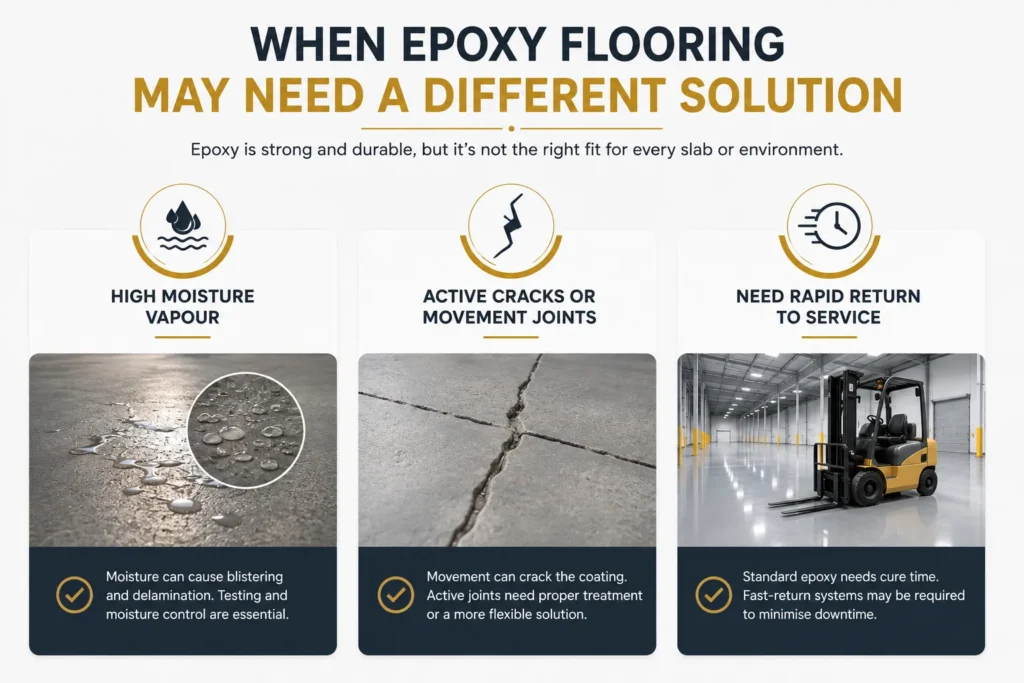
Concrete With High Moisture Vapour
Concrete with high moisture vapour can cause epoxy to blister, delaminate, or lose adhesion. Moisture testing should be completed before the system is chosen.
A moisture-mitigation primer may be suitable in some cases. However, ongoing water pressure, rising damp, poor drainage, or water entry from below the slab may need separate rectification before coating can proceed.
Slabs With Active Cracks or Movement Joints
Epoxy is a rigid material. If a slab has active cracks or movement joints, the movement can transfer through the coating and cause visible cracking.
Static cracks can often be repaired before coating. Active joints should be treated as movement details, not simply covered with rigid epoxy. In some cases, a more flexible system or a different floor solution may be needed.
Floors That Need Rapid Return to Service
Standard epoxy systems need sufficient cure time before heavy use. If a commercial floor must reopen quickly, a faster-curing resin system may be more suitable.
The decision should consider the required reopening time, temperature, traffic type, and whether the floor will be exposed to vehicles, equipment, cleaning, or chemicals immediately after installation.
How Apex Epoxy Perth Helps You Choose the Right Flooring System
A suitable epoxy floor starts with the concrete and how the space is used. Apex Epoxy Perth assesses the slab, exposure conditions, traffic, required finish, and safety needs before recommending a system for your home or business.
We Assess the Concrete Before Specifying a System
Every floor is checked for existing coatings, oil contamination, cracks, surface damage, moisture concerns, drainage, and exposure to sunlight. This helps determine whether the floor needs repairs, a moisture-control primer, a higher-build system, or a UV-stable topcoat.
We Prepare the Surface for a Reliable Bond
Proper surface preparation is essential for epoxy performance. Our process can include diamond grinding, existing coating removal, crack repairs, joint treatment, and cleaning contaminated concrete before the coating system is applied.
We Match the Finish to the Area
Garage floors, workshops, patios, pool surrounds, showrooms, and warehouses all need different levels of durability, texture, and UV protection. We help select a system that suits the floor’s use, from full-flake garage finishes to commercial solid-colour and anti-slip epoxy systems.
Built for Perth Conditions and Backed by Workmanship
For sun-exposed areas, we specify suitable UV-stable topcoats to help protect the finish from Perth heat and sunlight. Every Apex Epoxy Perth installation is completed with attention to preparation and system compatibility and is backed by a 5-year workmanship warranty.
Frequently Asked Questions About Types of Epoxy Flooring
What Type of Epoxy Flooring Is Best for a Garage?
Full-flake epoxy is often the best all-round garage system because it is durable, decorative, easy to maintain, and better at disguising dust and tyre marks than a plain colour. A UV-stable topcoat is important if the garage receives regular sunlight.
Is Full-Flake Epoxy Better Than Solid-Colour Epoxy?
Neither is universally better. Full-flake epoxy suits garages, workshops, and practical decorative spaces, while solid-colour epoxy suits clean, uniform commercial, warehouse, and industrial finishes.
The best choice depends on traffic, maintenance, safety, and appearance.
Is Metallic Epoxy Suitable for High-Traffic Floors?
Metallic epoxy can suit moderate indoor traffic when protected with a suitable clear topcoat. It is usually better for feature areas, homes, showrooms, and retail spaces than heavy workshops, warehouses, or exposed outdoor floors.
Is Epoxy Flooring Suitable for Outdoor Areas in Perth?
Epoxy can be used in outdoor systems when the concrete is suitable and the system includes a UV-stable topcoat. Patios, alfresco areas, pool surrounds, and driveways also need the correct texture, drainage, and weather-resistant specification.
Can Epoxy Be Applied Over Cracked or Previously Coated Concrete?
Epoxy can be applied after suitable preparation and repair. Static cracks may be repaired and ground flush, while failed coatings need removal. Active cracks, movement joints, moisture issues, and weak concrete need further assessment before coating.
What Is the Difference Between Epoxy and Polyaspartic Flooring?
Epoxy is commonly used for adhesion, build thickness, and decorative system layers, while polyaspartic is often used as a fast-curing, UV-stable protective topcoat. Many high-performance floors use both materials within one complete system.
Conclusion
The right epoxy flooring system is selected by matching the concrete condition and operating environment to the required finish. Full-flake systems suit many garages and practical residential spaces.
Self-levelling and metallic epoxy suit refined indoor finishes. Quartz, mortar, and ESD systems are designed for specific commercial and industrial requirements.
For a floor that lasts, the system needs more than a colour choice. It needs proper surface preparation, crack and joint treatment, the right build thickness, suitable slip resistance, and a UV-stable topcoat where sunlight is present.
Apex Epoxy Perth assesses these details before recommending a system, with professional concrete preparation and a 5-year workmanship warranty.