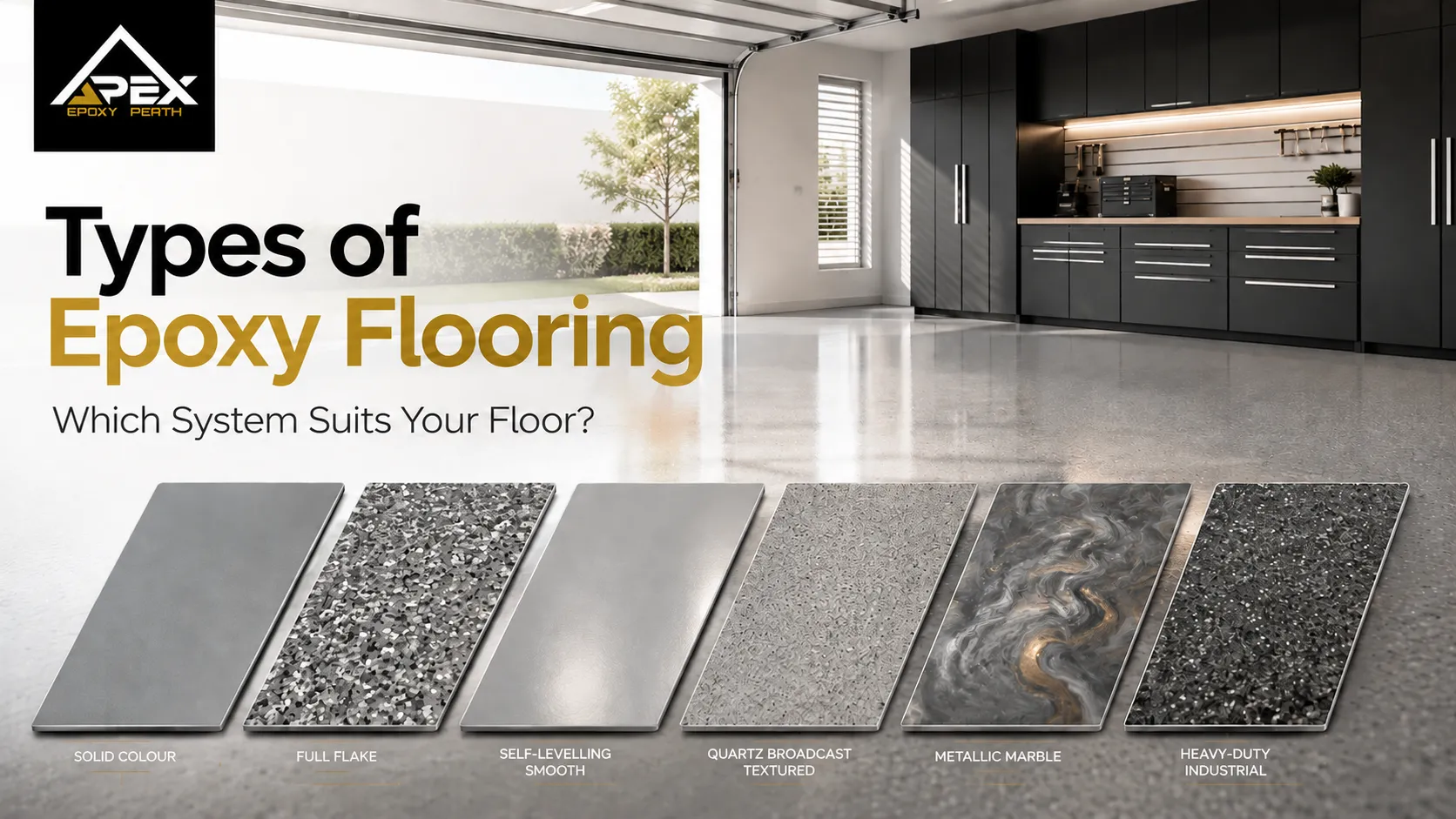

Epoxy flooring is a resin-and-hardener coating system that cures into a hard, bonded surface over concrete.
When the concrete is dry, sound, mechanically prepared, and matched with the right coating system, epoxy can provide many years of protection from dust, stains, abrasion, vehicle traffic, and everyday wear. Its lifespan is not determined by the word “epoxy” alone.
Surface preparation, slab moisture, coating build, UV exposure, traffic, and maintenance all affect how long the floor remains bonded and functional. A floor can lose some gloss before it loses performance, while peeling or bubbling usually signals an installation or substrate problem that needs attention.
How Long Does Epoxy Flooring Last?
A professionally installed epoxy flooring system commonly lasts 10 to 20 years in a residential setting, while demanding commercial and workshop floors may have a shorter service life unless they are specified for heavier traffic, abrasion, chemicals, or UV exposure.
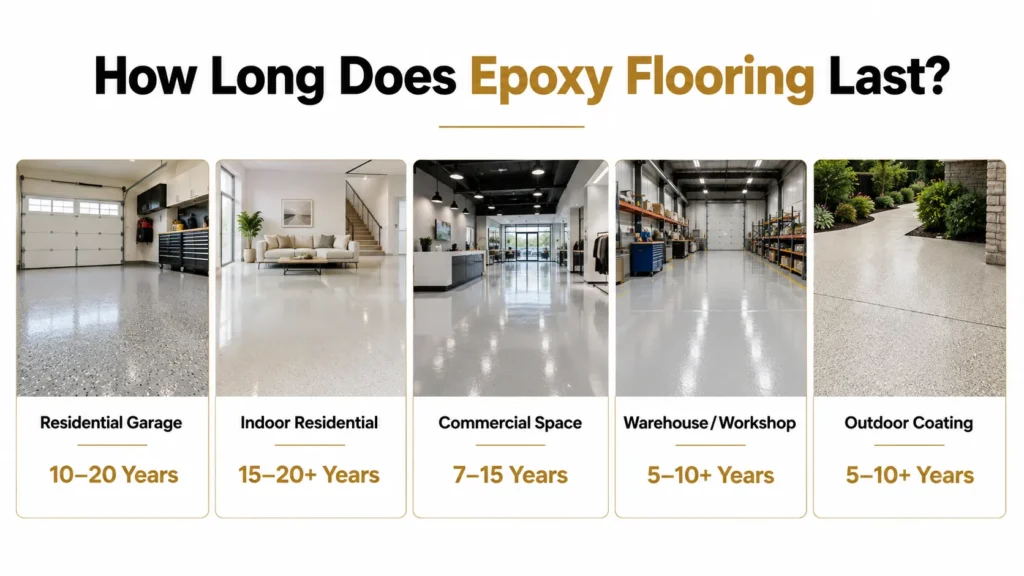
The ranges below are practical planning estimates, not a product warranty. The actual outcome depends on the concrete condition, use of the space, coating system, and maintenance.
| Application | Typical conditions | Typical service-life range |
| Residential garage | Cars, light tools, oil drips, moderate foot traffic | 10–20 years |
| Indoor residential area | Light foot traffic, low UV exposure | 15–20+ years |
| Commercial space | Regular foot traffic, frequent cleaning, trolleys or light equipment | 7–15 years |
| Warehouse or workshop | Forklifts, wheeled equipment, impacts, abrasion, chemicals | 5–10+ years with a correctly specified heavy-duty system |
| Outdoor concrete coating | Sun, heat, rain, thermal movement, vehicle or foot traffic | 5–10+ years when protected with a UV-stable topcoat |
1. Residential Garage Epoxy Flooring Lifespan
Residential garage epoxy flooring commonly lasts 10 to 20 years when it is installed over properly prepared concrete and used for normal vehicles, storage, and home workshop activity.
Hot tyres, dropped tools, oil, and tyre marks do not automatically damage a correctly specified system, but they can shorten the life of a thin or poorly bonded coating.
The floor should be diamond-ground, repaired where needed, and allowed to cure fully before vehicles return. A quality topcoat also helps the floor resist tyre marking, scratches, and routine cleaning.
2. Indoor Residential Epoxy Flooring Lifespan
Indoor residential epoxy flooring can last 15 to 20 years or longer because it usually receives lighter traffic and little direct ultraviolet exposure.
Laundry rooms, living areas, hallways, and internal utility spaces place less stress on a coating than garages or workshops.
Spills, grit, furniture dragging, and movement in the concrete can still cause damage. A durable indoor floor needs a sound slab, suitable joint treatment, and cleaning products that do not leave a residue or attack the topcoat.
3. Commercial Epoxy Flooring Lifespan
Commercial epoxy flooring generally lasts about 7 to 15 years, depending on foot traffic, wheeled loads, cleaning frequency, and chemical exposure.
Retail spaces, showrooms, offices, clinics, and food-preparation areas do not all need the same build or topcoat.
A floor used by customers and staff may mainly need abrasion resistance and easy cleaning.
A commercial kitchen, automotive space, or production area may also need chemical resistance, extra slip resistance, or a more flexible topcoat. Specifying the system around the actual use is more important than choosing a generic epoxy product.
4. Warehouse and Workshop Epoxy Flooring Lifespan
Warehouse and workshop epoxy flooring can last from 5 to 10 years or longer when the system is designed for forklift traffic, heavy equipment, point loads, impacts, and abrasive debris. In these environments, a thin decorative coating is rarely enough.
High-build epoxy, aggregate broadcast systems, protective topcoats, and correctly treated joints can extend service life.
The concrete beneath the coating also matters. Weak, dusty, cracked, or moisture-affected concrete can fail before the coating itself reaches the end of its useful life.
5. Outdoor Epoxy Coating Lifespan
Outdoor epoxy coating needs UV protection because standard epoxy can yellow, fade, or chalk under prolonged sunlight. For patios, alfresco areas, driveways, and pool surrounds, epoxy is usually used as part of a system with a UV-stable polyaspartic or polyurethane topcoat.
Perth heat, direct sun, rain, and concrete movement place extra stress on outdoor coatings.
The right topcoat helps retain colour and appearance, but it does not remove the need for correct preparation, drainage, slip resistance, and joint treatment.
What Does Epoxy Flooring Durability Mean?
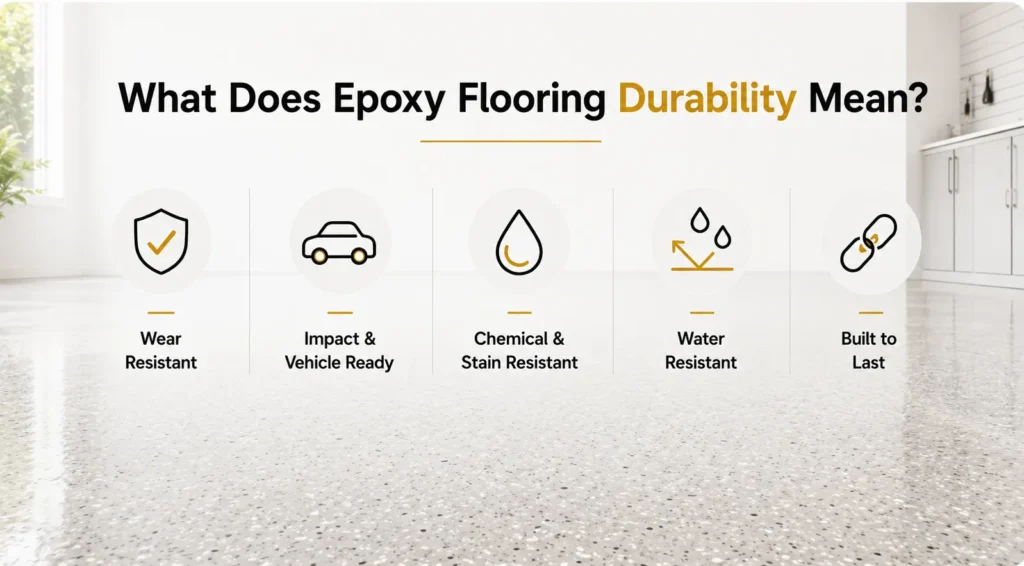
Epoxy flooring durability means the coating remains firmly bonded to the concrete and continues to resist the wear it was designed for.
A durable floor is not simply a hard, glossy floor. It must handle traffic, impacts, spills, cleaning, and environmental exposure without peeling, softening, cracking, or becoming unsafe.
1. Abrasion and Scratch Resistance
Epoxy resists abrasion better than standard concrete paint and helps protect concrete from dusting and surface wear.
Fine grit, sand, metal filings, and repeated wheeled traffic act like sandpaper, so they can eventually dull a topcoat or wear down high-traffic paths.
Sweep or vacuum abrasive debris regularly. For workshops and commercial areas, an abrasion-resistant topcoat or aggregate system can provide more protection than a smooth, thin coating alone.
2. Impact and Vehicle Resistance
Epoxy can handle normal vehicle loads, parked cars, hand trolleys, and dropped household tools when the system is built for the space.
Its performance depends on the strength of the concrete, the coating thickness, and whether point loads or heavy machinery are involved.
Heavy steel wheels, forklifts, pallet jacks, jack stands, and repeated impacts can damage an unsuitable system.
A workshop or warehouse needs a coating specification that accounts for the equipment actually used on site.
3. Resistance to Oils, Chemicals, and Stains
Epoxy creates a seamless surface that makes many oil, fuel, and household spills easier to remove than they are from bare concrete. It does not make every floor resistant to every chemical.
Strong acids, solvents, brake fluid, hot oils, and repeated chemical exposure can stain, soften, or degrade an unsuitable coating.
Tell the installer about oils, cleaning products, chemicals, and operating temperatures before the system is selected.
4. Water Resistance and Easy-Clean Performance
An intact epoxy floor resists surface water and prevents many spills from soaking into the concrete as quickly as they would on an uncoated slab.
The seamless finish also makes sweeping and mopping simpler.
Water resistance is different from moisture control beneath the floor. Moisture vapour moving up through concrete can disrupt the bond below an epoxy coating.
Water should also not be allowed to sit on a smooth floor where it creates a slip risk.
5. Limits of Epoxy Flooring Durability
Epoxy is hard and durable, but it is not indestructible. It cannot stop structural cracks from moving through unstable concrete, compensate for moisture pressure in an untreated slab, or remain colour-stable in strong sun without a suitable UV-stable topcoat.
It can also be damaged by sharp impacts, dragged metal objects, and chemicals outside its resistance rating.
A durable result comes from matching the coating system to the risks of the space.
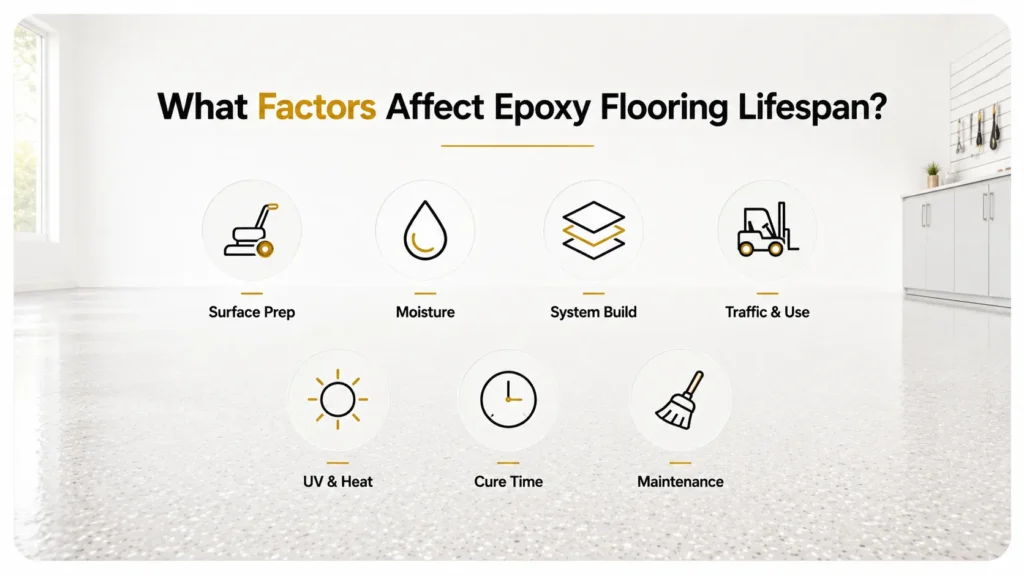
What Factors Affect Epoxy Flooring Lifespan?
Epoxy flooring lifespan is decided before the final coat is applied. The condition of the concrete and the quality of the preparation often matter more than the visible finish.
Concrete Condition and Surface Preparation
Concrete condition and mechanical surface preparation are the foundation of epoxy durability.
The slab needs to be sound, clean, and free from weak surface laitance, oil, curing compounds, failed paint, and loose material before coating begins.
Diamond grinding opens the concrete surface and creates a mechanical profile for the coating to bond to.
Cracks, spalls, and damaged areas should be assessed and repaired before the basecoat is applied. Applying epoxy over contamination or a weak concrete surface can lead to peeling and delamination.
Moisture in the Concrete Slab
Moisture in concrete can cause bubbling, blisters, or bond failure when vapour pressure builds beneath a coating. This issue is different from a floor simply looking dry on the day of installation.
Moisture testing helps determine whether the slab is suitable for the selected system or whether a moisture-mitigation primer is needed.
This is particularly important for ground-level slabs, areas without a vapour barrier, and concrete with a history of dampness or coating failure.
Epoxy Type, Build Thickness, and Topcoat
Epoxy type, coating build, and topcoat determine how well the floor handles wear. A thin roll-on coating has less material to absorb scratches, impacts, and abrasion than a multi-layer system with a suitable topcoat.
The system should be selected for the application. A decorative full-flake garage floor, a smooth internal floor, and a heavy-duty workshop floor may all use epoxy, but their primer, build, aggregate, and topcoat requirements can be different.
Traffic, Equipment, and Daily Use
Traffic reduces lifespan when the system is not designed for the load. Vehicle turning points, forklift routes, loading areas, workbenches, entryways, and door thresholds often wear faster than the rest of the floor.
Consider the type of wheels, frequency of traffic, vehicle weight, dropped tools, standing water, and cleaning equipment. Reinforcing high-wear zones during installation is more effective than waiting for damage to appear.
UV Exposure, Heat, and Temperature Changes
Ultraviolet light and heat can change the appearance and performance of unprotected epoxy.
Direct sun can cause conventional epoxy to amber, fade, or chalk, while heat and temperature changes make the concrete expand and contract.
Use a UV-stable topcoat for exposed areas. Expansion and control joints should be treated as movement points rather than simply covered with a rigid coating that may crack when the slab moves.
Installation Quality and Cure Time
Installation quality affects adhesion, thickness, appearance, and long-term performance.
Incorrect mixing ratios, poor mixing, unsuitable weather conditions, missed recoat windows, or contamination between coats can weaken the system.
The floor must also cure for the period stated in the product technical data. A surface can feel dry before it has developed full hardness and chemical resistance.
Returning vehicles, furniture, or heavy equipment too early can mark or damage the new coating.
Cleaning and Ongoing Maintenance
Cleaning and maintenance protect the topcoat from abrasive debris, staining residues, and unnecessary chemical exposure. Most epoxy floors need simple routine care rather than intensive maintenance.
Use a soft broom, vacuum, microfibre mop, or auto scrubber with suitable pads.
Clean spills promptly and avoid highly acidic, highly alkaline, or solvent-based cleaners unless the coating manufacturer confirms they are suitable.
Why DIY Epoxy Floors Often Fail Earlier Than Professional Systems
DIY epoxy floors often fail earlier because the concrete receives limited preparation and the product system is not tailored to the slab or the way the floor will be used.
The result may look good at first but lose adhesion when traffic, moisture, or heat exposes the weak point.
Acid Etching vs Diamond Grinding
Acid etching may be accepted for limited products and suitable concrete, but it cannot reliably remove old coatings, oil contamination, weak surface material, or uneven concrete.
It also depends heavily on correct cleaning and neutralisation after etching.
Diamond grinding mechanically removes surface contaminants and opens the concrete to create a consistent profile for the coating. It also makes it easier to identify cracks, soft areas, and previous coating failure before the epoxy is applied.
Thin Coatings vs Multi-Layer Flooring Systems
Thin coatings have less build and less capacity to resist abrasion, impact, and wear. They may suit light-duty applications, but they are less forgiving in garages, workshops, or commercial areas.
A professional multi-layer system can include a primer, epoxy basecoat, decorative flakes or aggregate where required, and a protective topcoat.
Each layer has a purpose: adhesion, build, appearance, slip resistance, UV protection, or additional wear resistance.
Product Selection, Mixing, and Application Control
Epoxy products have specific mixing ratios, pot lives, recoat windows, and temperature limits.
Inaccurate mixing or applying the material after its working time can leave soft spots, uneven gloss, weak adhesion, or incomplete curing.
Professional installation controls these variables and selects compatible products for the project.
This matters most where a floor has moisture concerns, old paint, chemical exposure, outdoor sun, or heavy traffic.
How Different Epoxy Flooring Systems Affect Durability
Different epoxy flooring systems provide different levels of protection. The most durable option is the one designed for the concrete and service conditions, not necessarily the thickest or most decorative-looking floor.
| System type | Suitable use | Key durability consideration |
| Solid-colour epoxy | Garages, internal rooms, light commercial spaces | Requires a suitable topcoat where abrasion, tyre marks, or UV exposure are expected |
| Full-flake epoxy system | Garages, showrooms, patios, work areas | Flakes improve appearance and can add texture; the topcoat protects the system from wear and staining |
| High-build or aggregate system | Workshops, warehouses, commercial production areas | Built for heavier loads, abrasion, and slip-resistance requirements |
| Epoxy with UV-stable topcoat | Alfresco areas, patios, pool surrounds, sun-exposed entries | The topcoat protects against yellowing and chalking from sunlight |
Solid-Colour Epoxy Flooring
Solid-colour epoxy flooring provides a clean, seamless finish that suits garages, internal rooms, and selected commercial areas.
Its durability depends on the epoxy build, the concrete preparation, and whether a protective topcoat is included.
Smooth solid-colour floors can show scratches, dust, and tyre marks more clearly than flake systems. They may also need an anti-slip additive in wet or work areas.
Full-Flake Epoxy Flooring
Full-flake epoxy flooring uses decorative vinyl flakes broadcast into the coating before a clear topcoat seals the surface.
It is a practical option for garages because it hides minor dust, small marks, and variations in the concrete better than a plain solid-colour finish.
The flakes do not replace correct preparation or topcoat protection. The system still needs proper adhesion, a suitable clear coat, and an appropriate texture level for the area.
High-Build and Heavy-Duty Epoxy Flooring
High-build and heavy-duty epoxy flooring is designed for areas with greater abrasion, impacts, chemicals, or wheeled traffic.
It may include extra coating build, aggregate, reinforced traffic zones, or a more chemical- and abrasion-resistant topcoat.
This type of system suits warehouses, workshops, plant rooms, and commercial work areas. It should be specified around the actual load and environment rather than chosen only by appearance.
Epoxy Floors With UV-Stable Polyaspartic or Polyurethane Topcoats
UV-stable polyaspartic or polyurethane topcoats protect epoxy floors exposed to sunlight. They reduce yellowing, fading, and chalking, and can improve abrasion and stain resistance depending on the product.
They are particularly relevant for Perth patios, alfresco areas, driveways, pool surrounds, and garages with strong direct light. A UV-stable topcoat protects the surface layer; it cannot fix moisture pressure, poor concrete preparation, or structural movement below the coating.
Common Epoxy Flooring Problems That Reduce Lifespan
Most early epoxy flooring problems are linked to a bond issue, moisture issue, movement in the concrete, or a coating system that does not match the environment. Cosmetic wear should be separated from defects that affect safety or adhesion.
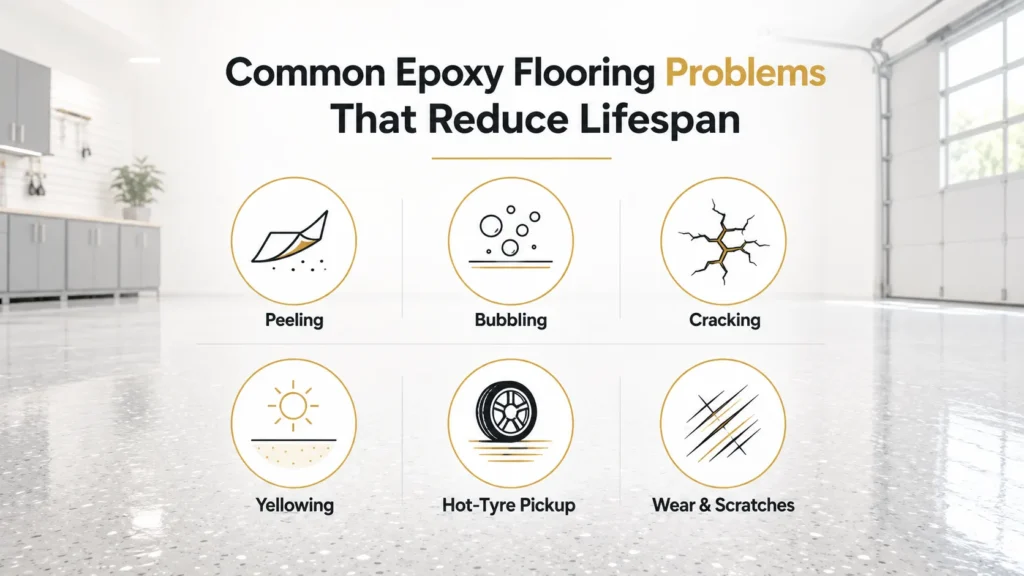
| Problem | Common cause | Appropriate response |
| Peeling or delamination | Poor preparation, oil contamination, moisture, weak concrete | Assess the bond and substrate before local repair or full removal |
| Bubbling or blistering | Moisture vapour, trapped air, contamination, application conditions | Identify the moisture source before recoating |
| Cracking | Concrete movement, untreated joints, impact damage | Repair where suitable and keep movement joints functional |
| Yellowing or fading | Direct UV exposure | Apply or renew a compatible UV-stable topcoat where appropriate |
| Hot-tyre pickup | Unsuitable coating, incomplete cure, poor bond | Repair damaged areas and review system selection and cure process |
| Worn texture or scratches | Abrasive debris, high traffic, inadequate topcoat | Clean, inspect, and recoat before the base system is exposed |
Peeling and Delamination
Peeling and delamination mean the coating has lost its bond to the concrete. This is not normal surface wear.
Common causes include inadequate grinding, oil or silicone contamination, moisture pressure, failed paint below the new coating, and weak concrete at the surface.
A small local area may be repairable after the cause is corrected. Widespread peeling normally requires removal of the failed material and proper preparation of the concrete before a new system is installed.
Bubbling and Blistering
Bubbling and blistering occur when pressure or contamination interrupts the bond between the coating and the substrate.
Moisture vapour is a common cause, but trapped air, outgassing concrete, incorrect application conditions, and contamination can also contribute.
Do not simply coat over blisters. The affected areas should be opened, assessed, and repaired only after the underlying cause has been addressed.
Cracking and Joint Failure
Cracks in the coating often reflect cracks or movement in the concrete below. Some static cracks can be repaired before coating, but expansion joints and moving control joints need a system that allows for movement.
Rigidly coating across an active joint can lead to a visible crack in the finish. Joint condition should be checked as part of the surface-preparation stage, especially in garages, warehouses, and outdoor slabs.
Yellowing, Fading, and Chalking
Yellowing, fading, and chalking are common signs of ultraviolet exposure on unprotected epoxy.
They can affect appearance before they affect adhesion, but the surface should be assessed if the finish becomes powdery, thin, or difficult to clean.
Use a compatible UV-stable topcoat in areas exposed to the sun. This is a system-design decision that should be made before installation, not only after discolouration appears.
Hot-Tyre Pickup and Tyre Marks
Hot-tyre pickup occurs when a tyre transfers heat and pressure to a coating, causing the surface to mark or lift. It is more likely where the coating has not cured fully, the bond is weak, or the system is not suitable for vehicle use.
Allow the full cure time before driving on a new garage floor. Keep tyres clean, remove oil and rubber residues promptly, and use a properly specified topcoat for vehicle traffic.
Surface Wear, Scratches, and Loss of Slip Resistance
Surface wear, scratches, and loss of texture usually develop first in traffic lanes, entry points, loading areas, and work zones. These issues may be cosmetic at first, but worn texture can reduce slip resistance and expose the base layers to faster damage.
Inspect high-wear zones regularly. A maintenance topcoat can often restore appearance and protection before full coating replacement is needed.
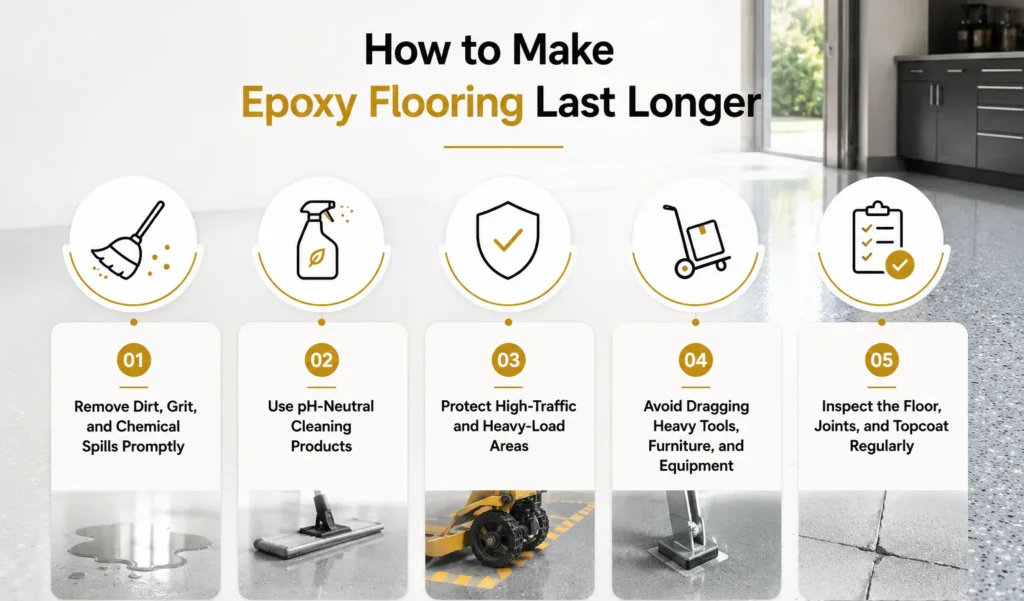
How to Make Epoxy Flooring Last Longer
Epoxy flooring lasts longer when abrasive dirt, standing spills, harsh cleaners, and preventable impacts are managed before they damage the topcoat. Simple maintenance protects both appearance and function.
Remove Dirt, Grit, and Chemical Spills Promptly
Remove grit and dry debris regularly because it scratches the surface under foot traffic and vehicle tyres. Clean oil, fuel, chemicals, and food spills promptly so they do not stain the finish or sit on the coating longer than necessary.
Use absorbent material for larger spills, then clean the affected area with water and a compatible neutral cleaner. Follow the relevant safety procedure for hazardous chemicals.
Use pH-Neutral Cleaning Products
Use pH-neutral cleaners and clean water for routine mopping. Highly acidic, highly alkaline, abrasive, or solvent-heavy cleaners can dull the topcoat, leave residue, or reduce performance if they are not compatible with the coating.
Check the coating manufacturer’s maintenance guidance before introducing a new degreaser or commercial cleaning chemical. In commercial settings, cleaning products should be part of the flooring specification.
Protect High-Traffic and Heavy-Load Areas
Protect high-traffic and heavy-load areas before visible damage develops. Use floor protection beneath equipment where appropriate, manage forklift and pallet-jack routes, and consider mats or sacrificial protection in loading zones.
Avoid turning heavy wheeled equipment sharply in one place whenever possible. Repeated point loading and tight turns wear the surface faster than straight-line traffic.
Avoid Dragging Heavy Tools, Furniture, and Equipment
Lift heavy tools, furniture, metal stands, and equipment rather than dragging them across the floor. Dragging concentrated metal edges can gouge the topcoat or damage the coating system.
Use protective feet, rubber pads, or suitable equipment wheels where needed. Jack stands and sharp-edged workshop equipment should not be placed directly on an unprotected coating unless the system is rated for that use.
Inspect the Floor, Joints, and Topcoat Regularly
Inspect the floor, joints, edges, and high-traffic lanes every few months. Look for lifting edges, blisters, cracking, worn texture, exposed basecoat, and changes around drains or doorways.
Early repair limits the area that needs attention. If damage appears repeatedly in the same spot, identify the cause before applying a patch or maintenance coat.
Frequently Asked Questions About Epoxy Flooring Durability
How long does epoxy flooring last in a garage?
A professionally installed garage epoxy floor commonly lasts 10 to 20 years. The range depends on concrete preparation, moisture condition, system thickness, vehicle use, hot-tyre exposure, and cleaning practices.
Does epoxy flooring peel over time?
Epoxy flooring can peel when the bond to the concrete fails, but peeling is not an expected outcome of a properly prepared and correctly installed system.
Inadequate preparation, moisture pressure, oil contamination, failed paint, and weak concrete are common causes.
Is epoxy flooring durable enough for cars, tools, and heavy equipment?
Epoxy flooring is durable enough for cars, normal garage tools, and many commercial uses when the system is specified for those loads.
Heavy equipment, forklifts, pallet jacks, chemicals, and point loads may require a high-build or aggregate-reinforced system with a suitable topcoat.
Does epoxy flooring yellow in sunlight?
Standard epoxy can yellow, fade, or chalk in direct sunlight. A UV-stable polyaspartic or polyurethane topcoat helps protect the floor’s colour and finish in sun-exposed areas.
Can damaged epoxy flooring be repaired?
Local chips, scratches, and isolated wear can often be repaired. Widespread peeling, bubbling, or moisture-related failure usually needs a more thorough assessment, removal of failed material, and correction of the underlying cause before recoating.
How often should an epoxy floor be recoated?
Epoxy flooring does not need recoating on a fixed calendar schedule. Recoat or renew the topcoat when inspection shows thinning, loss of texture, widespread dulling, surface wear, or reduced protection in high-traffic areas.
A sound epoxy base can often remain in place while the protective topcoat is renewed.